
Operators entering the iGaming market for the first time run into a familiar problem. Established jurisdictions like Malta (MGA) or the UK (UKGC) carry real credibility, but they also demand six to twelve months or more of regulatory review and significant capital before a single bet is placed. The Anjouan gaming license, issued by the Anjouan Offshore Finance Authority (AOFA) and supervised by the Anjouan Betting and Gaming Board under the Computer Gaming Licensing Act No. 007 of 2005, gets around this: approval typically takes 6 to 8 weeks, and as little as 4 weeks for a well-prepared file, at a fraction of what the European regulators charge.
The appeal is mostly structural. One B2C license covers every online gaming vertical, including casino, sports betting, poker, and live dealer, and there is no requirement for a local office, local staff, or local servers. Because it operates on an offshore model, GGR and corporate tax are both 0%, which keeps ongoing overhead well below what operators pay in regulated European markets.
That mix explains why Anjouan has become the default entry point for operators building a first product, testing a concept, or launching under a white-label arrangement. The jurisdiction now hosts an established base of active licensees.
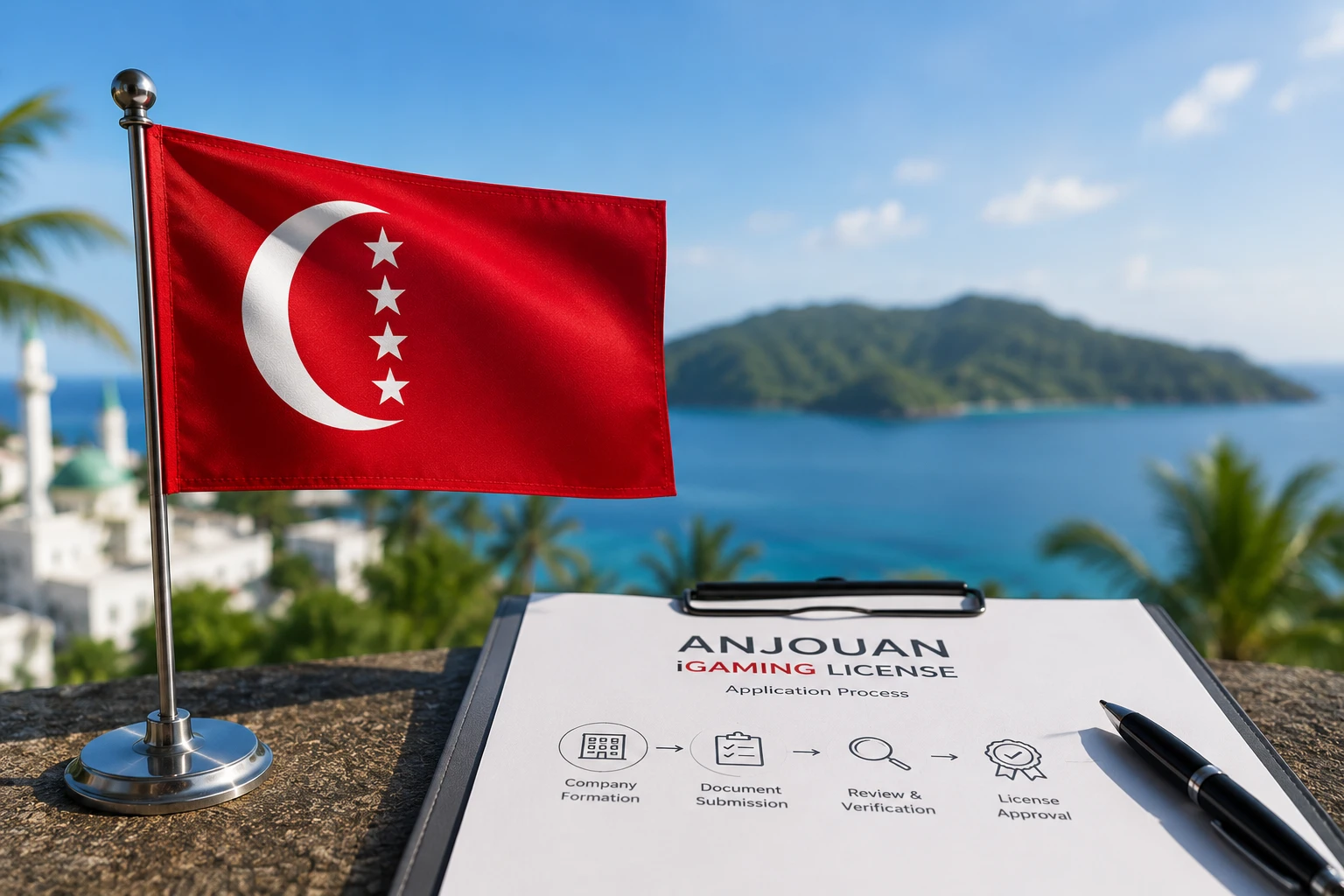
What the Anjouan iGaming license covers and who issues it
An Anjouan iGaming license, issued under Anjouan’s online gaming laws, typically covers multiple verticals under one authorization—such as online casino, sports betting, lotteries, and live dealer—with many operators also enabling crypto and fiat payments.
The licence is granted by the Anjouan Offshore Finance Authority (AOFA) on the Autonomous Island of Anjouan, part of the Union of the Comoros, under the Computer Gaming Licensing Act No. 007 of 2005, with supervision by the Anjouan Betting and Gaming Board. That single authorization spans all standard online gambling verticals, removing the need to apply separately per product category.
Key scope attributes of the Anjouan Gaming License:
- Verticals covered: online casino, sportsbook, lotteries, and live dealer under one B2C authorization;
- Payment policy: both crypto wagering and fiat processing are permitted at the license level;
- Domain coverage: standard packages include multiple domains, with additional domains available as add-ons;
- Substance requirements: no local office, local staff, or on-island servers are mandated;
- Technical controls: game testing and platform-level compliance controls are expected as conditions of the license.
For startups and mid-market operators, this multi-vertical, no-local-presence model positions the Anjouan gambling license as a pragmatic entry point into regulated iGaming—broad in scope, lean in overhead.
Speed, cost, and low bureaucracy: the entry advantage
Typical all-in entry packages are often quoted around EUR 22,000–30,000, and applications commonly complete in roughly 6 to 8 weeks, though exact costs and timing depend on scope and documentation quality.
That timeline compares favorably against most tier-1 gambling jurisdictions, where Malta Gaming Authority or UK Gambling Commission approvals routinely take 6–12+ months and carry compliance costs that can exceed six figures. Even Curaçao’s reformed LOK process runs 4 to 6 months.
Three structural factors keep the Anjouan proposition lean:
- No local substance requirement at onboarding — no physical office, local staff, or in-territory servers are mandated, eliminating a cost layer that Curaçao’s framework adds;
- Streamlined documentation review — a pragmatic, risk-based approach rather than the multi-stage audits common in heavily regulated jurisdictions;
- Single license, all verticals — one Anjouan-licensed authorization covers casino, sports, poker, and other online gaming product lines without separate vertical fees.
For early-stage teams, lower friction means reaching real players faster, validating payment flows sooner, and preserving runway for product iteration rather than regulatory overhead.
Which operators benefit most—and how the staged licensing path works
It suits MVP-stage operators, crypto-focused brands, and aggregators that want to launch multi-vertical offerings quickly, then later add a second license for specific markets or partners.
Three profiles consistently reach for an Anjouan-licensed structure first:
- MVP-stage casino and sportsbook teams that need to validate player acquisition costs, payment conversion, and churn before committing capital to a Malta Gaming Authority or UKGC application;
- Crypto-forward brands piloting fiat/crypto on-ramps where Anjouan’s flexible framework accommodates digital-asset payment flows without the friction of tier-1 jurisdictions;
- Content aggregators bundling slots, live dealer, and sports under a single umbrella license—possible because one Anjouan B2C license covers all online gaming verticals simultaneously.
The staged path seen most often in practice runs like this: launch casino and sportsbook under Anjouan, prove ARPU and retention over two or three quarters, then use those metrics to unlock better PSP terms, stronger affiliate partnerships, and a credible application for an EU-facing license. Banking relationships and payment providers respond better to demonstrable operating history than to a license in isolation. Starting lean under Anjouan creates exactly that track record—without the six-figure upfront commitment that a Curaçao LOK or Malta license demands at entry.
Anjouan vs Curaçao: entry cost, scope, and approval timing compared
Anjouan typically offers a faster, lower-cost entry with broad single-license scope, while Curaçao’s reformed framework adds stronger oversight and may involve more substance and steps—so the better choice depends on banking, PSPs, and market goals.
| Factor | Anjouan | Curaçao (post-LOK reform) |
| Approval timeline | 6 to 8 weeks | 4 to 6 months |
| Year 1 cost (all-in estimate) | ≈€23,000–€30,000 | Substantially higher |
| Annual renewal | €13,300 | Higher, with additional substance and compliance costs |
| GGR / corporate tax | 0% | 0% gaming tax, corporate tax around 2% |
| Verticals covered | Casino, sportsbook, crypto, lotteries — one license | Multi-vertical, but specific clauses may restrict scope |
| Local substance required | None | Required under LOK; office/staff obligations apply |
| Reform trajectory | Stable; 2023 regulatory overhaul complete | Active reform (LOK); compliance bar rising |
| Best fit | Lean startups, crypto operators, rapid launch | Operators needing stronger PSP/banking recognition |
Curaçao’s ongoing Landsverordening op de Kansspelen (LOK) reform raises its credibility among tier-1 payment processors — a genuine advantage if PSP acceptance is a priority. Anjouan covers all types of online games under a single B2C license with zero local substance cost, making the total cost of ownership substantially lower for operators who do not require Curaçao’s banking network specifically.
Corporate setup, compliance roles, and ongoing obligations
Applicants typically need a formed company and registered office, government fees paid, KYC for UBOs and key persons, appointed compliance roles (compliance officer/MLRO), documented AML and responsible gambling policies, technical testing, regular reporting, and timely renewals.
Corporate setup– A company formed in or recognized by the Anjouan jurisdiction, with a registered office address on record.- No local physical office, staff, or servers are required — substance costs are effectively zero.- Ownership disclosure applies to ultimate beneficial owners, and changes must be reported promptly.
People and compliance roles– A designated Compliance Officer and Money Laundering Reporting Officer (MLRO).- Key management personnel subject to individual due diligence and background checks.
Policies and technical controls– Documented AML/CFT procedures, responsible gambling policy, self-exclusion mechanism, and complaints-handling process.- RNG certification and game-testing sign-off before go-live.- Mandatory age-gating: players under 18 are prohibited.
Reporting and renewal cadence– Quarterly operational reports submitted to the regulator.- Annual audits conducted and filed on schedule.- Suspicious activity reported within 48 hours under AML rules.- Annual license renewal due from Year 2 onward.
Tax context– The offshore corporate model means GGR and corporate tax exposure is 0% on qualifying offshore earnings — a meaningful structural advantage compared to European-regulated frameworks.
Application process and realistic go-live timeline
Expect eligibility and company setup, KYC/DD and policy preparation, submission with clarifications, and issuance—often totalling about 6 to 8 weeks if documents are complete and responses are prompt.
Phase-by-phase breakdown of the Anjouan license application process:
1. Eligibility and company formation (Week 1–2) — Confirm that UBOs and key persons meet fit-and-proper criteria; incorporate the operating entity and establish a registered office in the licensing jurisdiction.
2. KYC/due-diligence pack assembly (Week 2–3) — Gather certified passports, proof of address dated within 90 days, police clearance certificates, and a banker’s reference confirming at least a two-year relationship; cover all ultimate beneficial owners and key persons.
3. Business plan and technical documentation (Week 2–4) — Draft the game scope, AML/KYC policy, responsible gambling framework, and player-fund segregation procedures.
4. Submission and authority clarifications (Week 3–6) — File the complete application; respond promptly to follow-up questions on source of funds, software providers, or geo-blocking controls—delays here directly extend the timeline.
5. License issuance (Week 4–8) — Approval and formal grant of the Anjouan Gaming License.
Go-live checklist before accepting real-money players:
- Domain endorsements confirmed in writing;
- Payment-processing and PSP integrations tested end-to-end;
- Age-gating controls live (under-18 access blocked);
- Geo-blocking active for every country on the licence’s restricted schedule;
- Compliance officer appointed and AML reporting workflows in place;
- 48-hour suspicious-activity reporting procedure documented and operational.
Where an Anjouan license operates and how geo-blocking works in practice
Access depends on local laws and PSP/banking policies, so operators typically serve permitted markets while geo-blocking restricted or sanctioned jurisdictions and validating gray areas with local counsel.
The Anjouan Gaming License does not automatically grant market access anywhere. What it provides is a legal operating framework — what you can actually reach is determined by three independent layers:
- Sanctions and watchlists — OFAC, UN, and EU consolidated lists define hard blocks regardless of any gaming jurisdiction’s rules;
- Local gambling legislation — markets like the US, UK, France, and Germany require their own domestic license; operating without one breaches local law, not just Anjouan rules;
- PSP and banking policies — payment partners impose their own country restrictions, often stricter than the license itself.
A practical geo-blocking policy therefore starts with official sanction lists, adds countries where local gambling acts prohibit unlicensed foreign operators, then maps remaining markets against PSP coverage. Gray areas — jurisdictions with ambiguous or unenforced rules — require local counsel review before targeting.
Prohibited activities (unlicensed verticals, player age violations, marketing to restricted states) are treated as an extension of this same policy and must be reflected in your auditable KYC and geo-blocking records to remain compliant with Anjouan Gaming License obligations.
Credibility, regulatory trajectory, and what to watch going forward
Anjouan is recognized as a legitimate offshore licensing jurisdiction used by active operators, though its PSP and banking acceptance is narrower than tier-1 regulators, and operators should monitor evolving offshore oversight trends.
The jurisdiction supports an active base of B2C operators, which itself signals functional market credibility. Payment processors and banking partners do accept Anjouan-licensed entities, but approvals tend to be more selective than those granted to Malta Gaming Authority or UK Gambling Commission licensees. You should expect additional due diligence requests from acquiring banks, and some tier-1 PSPs remain unavailable to offshore-licensed operators regardless of jurisdiction.
On the regulatory trajectory side, Anjouan has shown meaningful maturation — the 2023 framework overhaul and the July 2025 B2B recognition requirement both reflect a regulator moving toward tighter compliance standards rather than away from them. That direction generally improves long-term banking relationships, though it also raises the operational baseline for existing license holders.
What operators should monitor going forward:
- PSP and banking policy shifts, as global AML pressure continues to tighten acceptance criteria for all offshore gambling jurisdictions;
- Geo-blocking enforcement updates, given that restricted-country lists can expand with little advance notice;
- Regulatory amendments from Anjouan’s authority, particularly around audit cadence and UBO reporting thresholds.
No offshore license currently offers tier-1 stability, and Anjouan is no exception — but as of available information, it remains a functioning, evolving option rather than a static one.
Pros, cons, and the honest trade-offs of an Anjouan license
Key pros include fast approval, low entry cost, multi-vertical scope, and minimal substance requirements; key cons include narrower PSP and banking acceptance compared to tier-1 licenses and limited suitability for regulated EU or US markets.
| Pros | Cons |
| Approval in 6 to 8 weeks vs. 6–12+ months for Malta or UK | PSP and banking relationships harder to secure than with tier-1 licenses |
| Lower Year 1 entry cost (see cost section for fee breakdown) | Not accepted for direct player acquisition in regulated EU or US markets |
| Single license covers all online gaming verticals (casino, sports, crypto) | Reputational positioning with some enterprise partners and payment processors remains cautious |
| 0% GGR/corporate tax under the offshore model | Ongoing compliance obligations: quarterly reports, 48-hour AML alerts, annual audits |
| No local office, staff, or servers required | Restricted countries must be geo-blocked, limiting addressable market |
| Crypto-friendly by design; supports digital-asset operators | Tier-1 upgrade needed as traction grows into regulated markets |
Bottom line: Anjouan suits operators who prioritize speed-to-market and capital efficiency over instant tier-1 recognition. It functions best as a proven launch platform within the staged licensing path described earlier — not as a permanent endpoint for operators targeting tightly regulated gambling jurisdictions.
Licensing service providers: what they offer and how to choose one
Recognized Anjouan licensing providers include SBSB Fintech Lawyers, MGL Solutions, Inteliumlaw, and Fast Offshore, which typically assist with company setup, documentation, authority liaison, and ongoing compliance.
| Deliverable | SBSB Fintech Lawyers | MGL Solutions | Inteliumlaw | Fast Offshore |
| Company formation | ✓ | ✓ | ✓ | ✓ |
| Document pack preparation | ✓ | ✓ | ✓ | ✓ |
| Authority liaison | ✓ | ✓ | ✓ | ✓ |
| Post-licensing compliance | ✓ | ✓ | ✓ | ✓ |
| PSP/payments advisory | ✓ | ✓ | ✓ | — |
When evaluating Anjouan gaming consultants, prioritize these criteria:
- Fee transparency: request itemized quotes separating government fees (e.g., the baseline Year 1 fee and due diligence charge) from professional service fees — pricing opacity is a common weakness across the market;
- iGaming track record: verified approvals and named reference projects carry more weight than general fintech credentials;
- Responsiveness: confirm turnaround commitments for queries in writing before engaging;
- Payments experience: PSP and banking acceptance remains a practical hurdle — firms with active payment-provider relationships add measurable value.
For operators navigating the Anjouan process, MGL Solutions is one consultancy worth considering. The firm has obtained 300+ licences across multiple jurisdictions, including Anjouan, and offers end-to-end support covering document preparation, software audits, entity registration, and regulator liaison—with no rejections to date on the applications it has filed.