
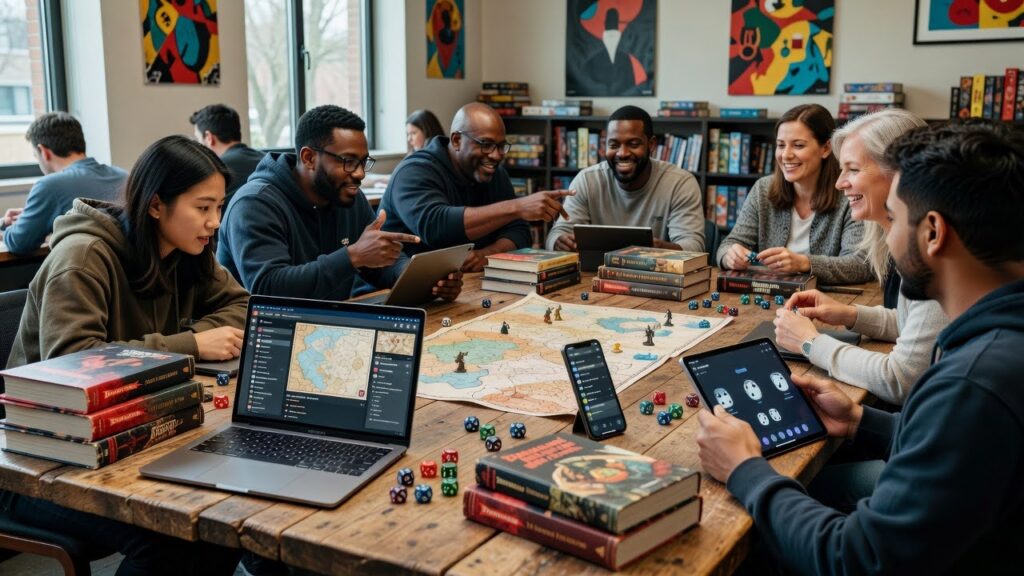
Challenges and Future Trends in Online Tabletop RPGs
Despite the digital renaissance, some challenges persist. Technical issues such as unstable internet connections, hardware disparities, and software glitches can disrupt the rhythm of a session. There’s also the question of maintaining an authentic social atmosphere—some players miss body language cues and spontaneous interactions unique to sharing a physical space. A growing concern for digital fatigue has emerged as more aspects of leisure and work shift online, prompting some communities to balance online innovations with traditional in-person play.
Looking forward, the intersection of technology and storytelling in RPGs is likely to deepen. AI-powered game assistants now help automate rule adjudication, generate dynamic story elements, or moderate online chats. Augmented and virtual reality prototypes offer the promise of 3D landscapes mapped to living rooms or immersive VR campaigns. As communities’ tastes and approaches diversify, bespoke online services become more valuable—streamlined character dashboards, session management, and community-specific mods underscore a trend toward personalization. As more communities seek custom solutions for their gaming needs, demand for specialized web development services is steadily growing.
From breaking down borders to elevating collaboration, digital tools have fundamentally transformed the world of tabletop RPGs in 2026. Whether you’re a game master building new worlds or a player venturing into them, the online renaissance offers endless opportunities for connection, creativity, and adventure.
The Digital Evolution of Tabletop RPGs
Dungeons & Dragons, created in the 1970s, set the foundation for countless other tabletop RPGs built around shared narrative, improvisation, and dice-rolling. For decades, sessions meant gathering around a physical table, face-to-face. However, as broadband internet and home computers became widely accessible in the late 1990s and early 2000s, the possibility of online play began to attract attention.
The earliest digital innovations included text-based MUDs (Multi-User Dungeons) and forums where players coordinated games asynchronously. But the past decade witnessed a boom in dedicated RPG sites and virtual tabletops (VTTs) designed specifically for real-time gaming. Tools such as Roll20 and Fantasy Grounds enabled real-time maps, dice-rolling, and audio-visual interactions no longer confined to a single living room. By expanding accessibility and removing the need for physical proximity, the nature of tabletop RPGs fundamentally changed—creating a truly global hobby.
Key Online Tools Empowering Players and Game Masters
Today’s digital ecosystem offers RPG participants a rich toolkit that streamlines nearly every phase of play. VTTs (Virtual Tabletop Tools) like Foundry VTT, Roll20, and Owlbear Rodeo provide interactive maps, dynamic lighting, customizable tokens, and integrated dice mechanics—all synchronized for remote collaboration.
Character generators such as D&D Beyond and Hero Lab reduce prep time, automating character builds while archiving rules and personalized content. Shared online drives (Google Drive, Notion) help store session notes, maps, handouts, and audio tracks in one place—making them accessible for the entire group.
Communication platforms—including Discord and Slack—are not only chat hubs but also support voice, video, and integration of bots for scheduling or automated dice rolls. For game masters, these tools simplify the management of complex campaigns, facilitate improvisation, and reduce technical friction for participants. The digital age has turned organizing and conducting an RPG session into a far more flexible process, allowing enthusiasts from different continents to gather around the same virtual table.
Building Communities in the Digital Age
The rise of online RPG hubs has fundamentally altered the social landscape for tabletop gaming. Specialized discussion forums (EN World, RPG.net), subreddits, and social media groups now connect tens of thousands of players and game masters worldwide. Through these channels, users exchange campaign ideas, review game systems, share homebrew content, and offer mentoring to beginners.
Internet-based services for finding gaming groups—such as StartPlaying, Meetup, and dedicated LFG (Looking For Group) systems—help match schedules and preferences, dramatically increasing participation rates. Online conventions and events now rival their in-person counterparts in attendance, featuring live-streamed sessions, Q&A panels, and workshops.
This digital expansion fosters both inclusivity and accessibility. People who previously struggled to find local groups—because of geography, disability, or social anxiety—can now join games tailored to their interests and needs. For the community, that means fresh perspectives, evolving playstyles, and an ever-expanding shared knowledge base.
Collaborative Storytelling and Enhanced Imagination Online
Moving into the digital realm has opened up novel ways of enhancing collective storytelling. Real-time collaborative note-taking through apps like Google Docs or Obsidian lets both players and game masters chronicle adventures, track character arcs, and annotate world lore on the fly. VTTs can instantly reveal new environments, animate monsters, and add atmospheric music or sound effects, boosting immersion far beyond what paper maps allow.
Streaming tools—such as Twitch or YouTube Live—have also spawned the phenomenon of “actual play” broadcasts, making campaign storytelling a participatory spectator sport. Many successful campaigns (like Critical Role or Dimension 20) demonstrate how digital formats support large-scale, community-driven tales where viewers influence story directions or contribute art and music.
These advancements mean that imagination is no longer restricted by the physical limitations of the table. Instead, each session becomes a multimedia experience with more vivid worlds and deeper collaboration—uniting players who might otherwise never meet.