
Most people who fall for a pale blue stone do not arrive with a checklist. They see the color, feel something, and only later start asking what actually goes into a ring they will wear for decades. The good news is that the whole choice comes down to a handful of decisions, each one independent of the last. Work through them in order and the process stops feeling like guesswork and starts feeling like design. This guide walks through the four that matter most, plus a few practical points that make the difference between a stone you like in the case and a ring you love on your hand.
Decision one: the color and tone you actually want
Aquamarine is not a single shade. It runs from a whisper of icy blue to a deeper sea-glass teal, and the tone you choose sets the personality of the whole ring. Lighter stones read as airy, modern, and understated; they catch daylight and almost disappear into it, which suits someone who wants quiet elegance. Deeper, more saturated stones carry more presence and photograph with obvious blue, which appeals to anyone who wants the color to be the story. There is no correct answer here, only a personal one. If you can, look at candidates in natural light and in warm indoor light, because the same stone can shift noticeably between the two. Reputable jewelers such as Aquamarise tend to describe tone honestly, which makes it far easier to picture the finished piece before you commit. Decide the color you love first, because every later decision either flatters it or fights it.
Decision two: the cut and how it moves light
Cut does two jobs at once. It shapes the outline of the stone, and it controls how light travels through it. Because aquamarine is naturally clear and cool, cuts that open up the surface tend to show the color beautifully. A few common directions worth weighing:
- Oval and pear stretch the stone, which can make the color look generous and the finger look longer.
- Emerald and step cuts use long, clean facets that give a calm, architectural, hall-of-mirrors effect rather than sparkle.
- Round and cushion deliver the most lively return of light and read as timeless and familiar.
None of these is objectively better. A step cut rewards a person who loves restraint; a round rewards someone who wants motion and fire. Match the cut to the color you chose in decision one, since a deeper stone can carry a bold outline while a paler one often looks its best in a shape that keeps things bright and open.
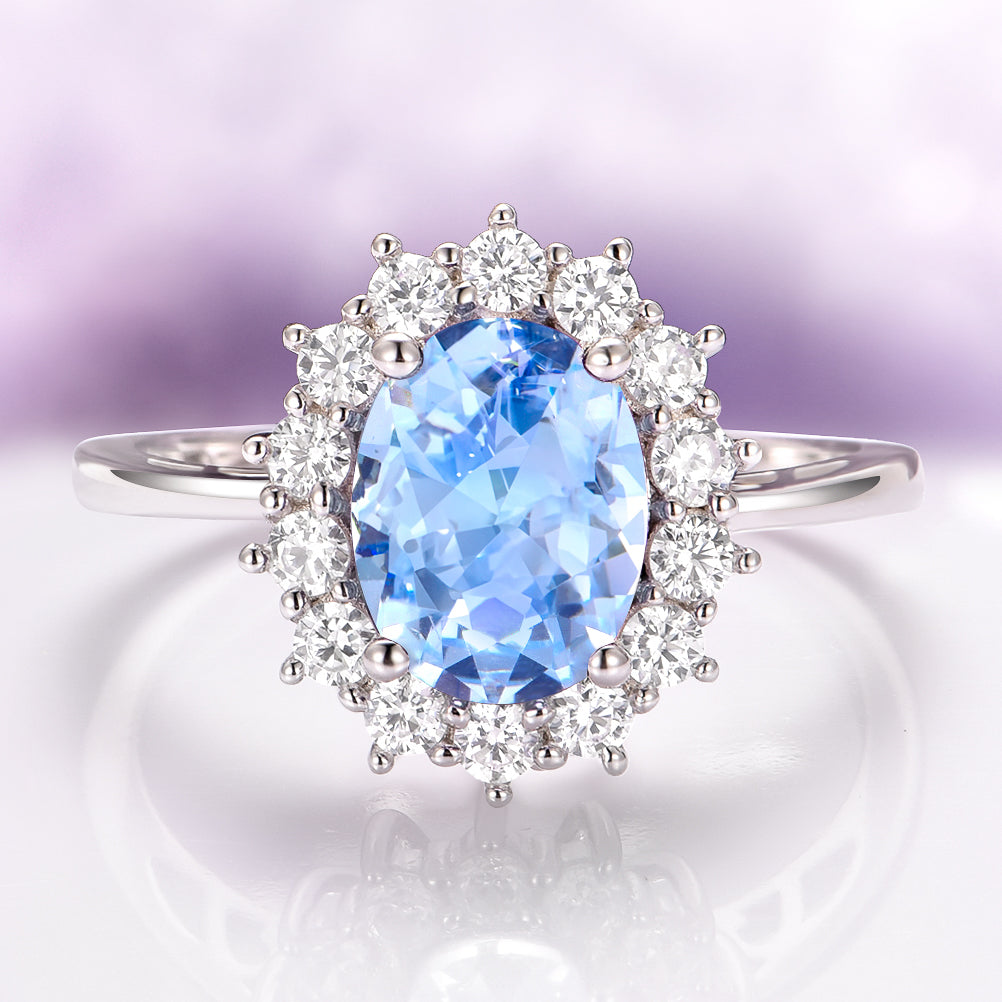
An oval aquamarine framed by a fine halo – one of many ways the stone gets set.
Decision three: the setting metal that frames the stone
The metal around the stone is not just structure; it is a color partner. Cool white metals sit quietly behind aquamarine and let the blue stay crisp and contemporary, which is why so many people default to them for this stone. Warm, yellow-toned metals do something more surprising: the warmth pushes against the cool blue and can make the color look richer and more vivid by contrast. Softer pink-toned metals split the difference, adding a romantic glow while still letting the stone breathe. There is no universal winner, only what flatters your skin and your taste. If you tend toward silvery, cool jewelry already, a white metal will feel like home; if your everyday pieces lean warm, do not assume aquamarine only works with white. Try the stone against each tone and trust your eye over the rulebook.
Decision four: the symbolism you want it to carry
Part of choosing this stone is choosing what it means to you. Aquamarine has long been tied to the sea, to calm water, and to safe passage; sailors once carried it as a talisman for steady journeys. For a couple, that reads naturally as a wish for smooth waters and a clear head through whatever comes. The color itself suggests openness, honesty, and a certain unhurried confidence. You do not have to buy into any of it literally for it to matter. Picking a stone whose meaning resonates gives the ring a quiet second layer, a private story that sits underneath the sparkle. When people ask about it later, you will have something to say that is about the two of you rather than about a spec sheet, and that is usually the part they remember.
How it wears from one ordinary day to the next
A ring you choose for a proposal is a ring you will also wear to type, cook, garden, and carry groceries. That daily reality deserves a decision of its own. Aquamarine is a durable stone, comfortably suited to everyday wear, but a very tall or exposed setting will catch on fabric and edges more than a lower, more protected one. A halo or a bezel tucks the stone in and gives it a guarded feel; a high solitaire shows the stone off but sits more in the world. Think honestly about your hands and your days. Someone who works with gloves, keyboards, or clay is better served by a design that keeps the stone close to the finger. Someone who wants maximum presence and is willing to be a little mindful can go taller. Comfort is not a compromise; it is what makes a ring one you never want to take off. If you are browsing an aquamarine engagement ring collection, filter your eye through this lens as much as through beauty.
Budgeting the decision as a set of trade-offs
Set exact numbers aside and think about budget as leverage instead. Every ring is a balance of four levers: the size of the stone, the intensity of its color, the intricacy of the setting, and the metal that carries it. Pull one up and you usually pull another down to keep the whole thing in proportion. Someone who wants a large stone might choose a lighter tone and a simpler setting to let it lead. Someone who loves detail might choose a more modest stone in a richly worked design so the craftsmanship becomes the point. There is no wrong balance, only the one that matches what you actually value. Decide which single element you care about most and let it win; then let the other three flex around it. That framing keeps the choice grounded in meaning rather than in a race for the biggest possible everything.
Bringing the four decisions together
Color, cut, metal, and meaning are not separate purchases; they are four turns of the same dial, and the ring you end up with is simply the sum of the answers you gave. Start with the tone you cannot stop looking at, choose a cut that shows it off, frame it in a metal that flatters your skin, and let the symbolism give it weight. Fold in how it will live on your hand day to day and which element you want to lead, and the ring practically designs itself. Take your time with each decision on its own terms, and you will not end up with a ring that merely looks impressive. You will end up with one that feels, quietly and completely, like yours.