
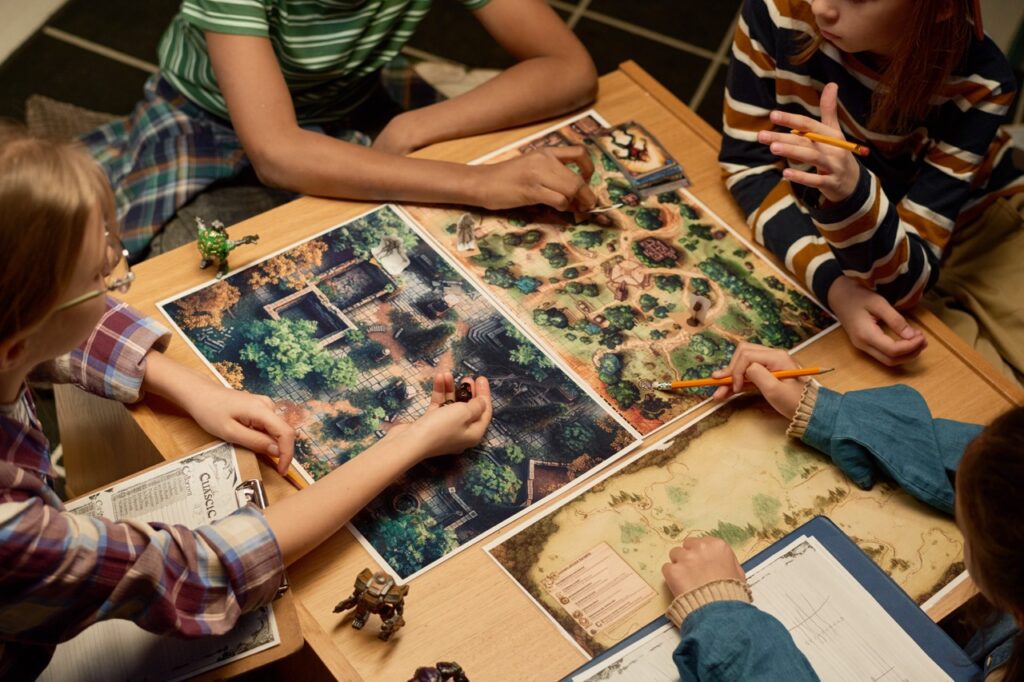
High angle of four intercultural youngsters gathered by table with new board game and playing while one of girls throwing dice
Every RPG player has been there. You need one successful roll to save your character from certain doom. The odds are in your favor, maybe 70% or even 80% chance of success. You roll the dice, watch them tumble, and somehow land on the worst possible result. Your character dies, the quest fails, and you’re left staring at those traitorous dice, wondering what just happened.
This relationship between probability, luck, and player psychology defines the RPG experience in ways that go far beyond simple mathematics.
The Dice Never Lie, But Our Brains Do
RPG players develop fascinating mental frameworks around probability that rarely match actual statistics. When someone rolls three critical failures in a row, they genuinely believe the dice are cursed or the game is rigged against them. Mathematically, these streaks happen exactly as often as they should. Our brains just aren’t wired to accept that.
This disconnect creates some interesting behaviors:
- Players blow on dice before important rolls
- Certain dice get “retired” after bad sessions
- Lucky dice earn permanent spots in dice bags
- Rolling techniques become personal superstitions
None of this affects actual probability, but it affects how players experience the game. And that experience matters more than the math.
Hot Streaks and Cold Dice: The Gambler’s Fallacy in Action
Most RPG players fall victim to the gambler’s fallacy without realizing it. After rolling poorly several times, they genuinely expect better results next time. “I’m due for a good roll” becomes a mantra, even though each dice roll exists independently from every other roll.
The opposite happens too. A player lands three critical hits consecutively and suddenly believes they’re unstoppable. This same excitement about streaks and the thrill of chance appears strongly when players get their first free credit in online casinos. Many new players start exactly this way with no-deposit bonuses that give them an immediate taste of luck, and a good overview of current offers like that can be found at https://pl.polskiesloty.com/darmowa-kasa-za-rejestracje-bez-depozytu/, where people often share their first experiences with randomness.
The psychology remains consistent whether someone’s rolling dice or spinning reels; humans struggle to truly internalize randomness.
Confirmation Bias and Selective Memory
Ask any gaming group about their most memorable rolls and you’ll hear stories about incredible successes or catastrophic failures. Nobody remembers the average rolls, even though those comprise the vast majority of gameplay.
This selective memory reinforces false beliefs about probability. A player convinces themselves that d20s “always” betray them during crucial moments because they vividly remember the handful of times it happened. They forget the dozens of sessions where rolls fell within expected ranges.
Game masters face this too. They remember the one time a random encounter almost killed the party but forget the countless encounters that went exactly as planned. These memories shape how both players and GMs approach probability going forward.
The Illusion of Control
RPG players love feeling like they can influence probability. Rolling techniques, dice selection, pre-roll rituals. These create an illusion of control over fundamentally random outcomes.
According to research, people perform better and feel more satisfied when they believe they have some control, even in situations governed purely by chance.
This extends to character-building choices. Players agonize over whether to take a +1 bonus to hit or a different ability, treating these small probability shifts as massively significant. In reality, that +1 might matter once every several sessions, but the decision feels monumental.
The illusion works because occasionally it appears to pay off. Someone rolls their “lucky” d20 and succeeds. The ritual gets reinforced and the cycle continues.
Risk Assessment and Decision Making
Despite misunderstanding probability, RPG players make risk-based decisions constantly. Should you attempt the difficult climb or take the long route? Attack the dragon or negotiate? Use your powerful spell now or save it?
Experienced players develop intuition about these choices, even if they can’t articulate the math. They learn through pattern recognition:
- Understand which risks worth taking based on party composition
- Recognize when resource conservation matters more than immediate success
- Identify situations where failure won’t derail everything
This practical knowledge often surpasses theoretical probability understanding. A player might not know the exact odds but knows from experience that their barbarian succeeds at strength checks “most of the time.”
Making Peace with Randomness
The healthiest approach combines accurate probability understanding with acceptance of short-term variance. Know the odds, make informed decisions, and accept whatever results come.
Veteran players develop this mindset through experience. They’ve seen enough sessions to understand that luck equalizes over time. Bad nights happen. Great nights happen. Most nights land somewhere in between.
This acceptance doesn’t mean abandoning the superstitions and rituals that make RPGs fun. Keep your lucky dice, blow on them before big rolls, and celebrate when probability works in your favor. Just remember that the dice don’t actually care about your ritual.
They’re just doing what dice do, tumbling randomly and creating the beautiful chaos that makes tabletop gaming unforgettable.