
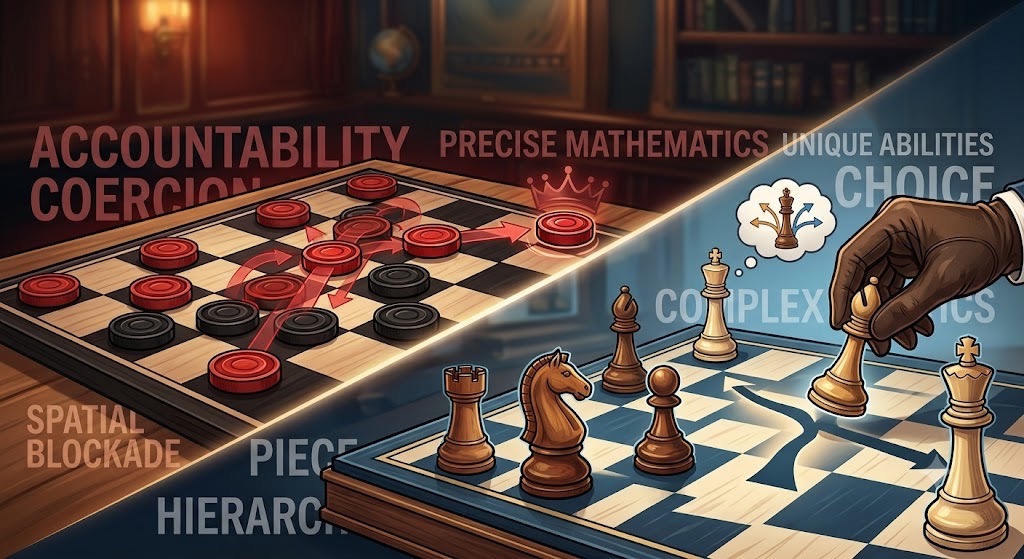
Among casual strategy enthusiasts, uniform board games are often overlooked for those with complex, asymmetric roles. However, by understanding what checkers can teach you that chess cannot, you will find something truly special about the game’s tactics. It is not simply a leisurely activity but rather an arena of severe punishment for every single action taken.
The removal of unique attributes from each piece demands a pure reliance on positioning, responses, and space. Understanding these mechanics elevates your broader strategic thinking and sharpens your board vision in ways that highly complex games rarely demand and also if you playing checkers online free on many apps it will not hole in your pocket and keep you away from the reels.
Forced Jumps and Mandatory Captures: Teaching Accountability
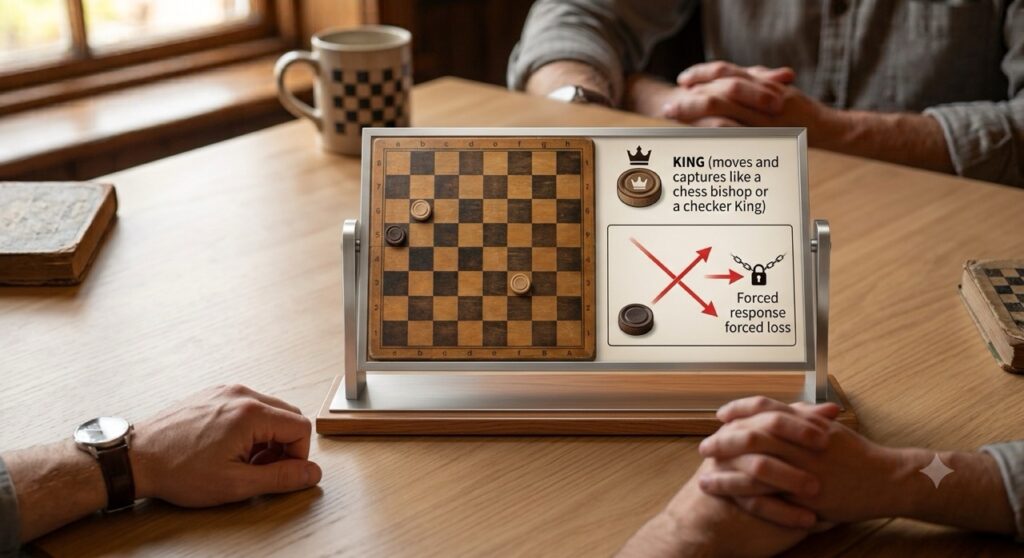
The foundational rule of checkers, and its greatest strategic engine, is the compulsory jump. If a capture is available, you must take it. This single rule shifts the mental dynamic from open-ended choice to strict linear calculation, and there comes the checkers strategy that you should understand before playing the game.
Whereas voluntary capture games allow players complete autonomy when choosing whether to attack, trade, or withdraw, checkers strips this decision from the player, giving them a unique tactical advantage by making their opponent do precisely what they want them to do.
- Calculated Coercion: Advanced strategy centers on offering deliberate piece sacrifices to force an opponent into a specific square.
- Sequence Control: Because captures are obligatory, you can dictate your opponent’s turn sequence 2 to 4 moves in advance, turning their turn into a mechanical execution of your plan.
- Proactive Defense: Knowing that your opponent can force your moves means you have to consider each one not only for where you are moving your piece, but also for what mandatory moves it creates for your opponent.
This way of playing under the mandatory rules helps your brain get used to thinking deterministically rather than probabilistically.
Uniform Piece Speed: Building Discipline Without “Hero Pieces”
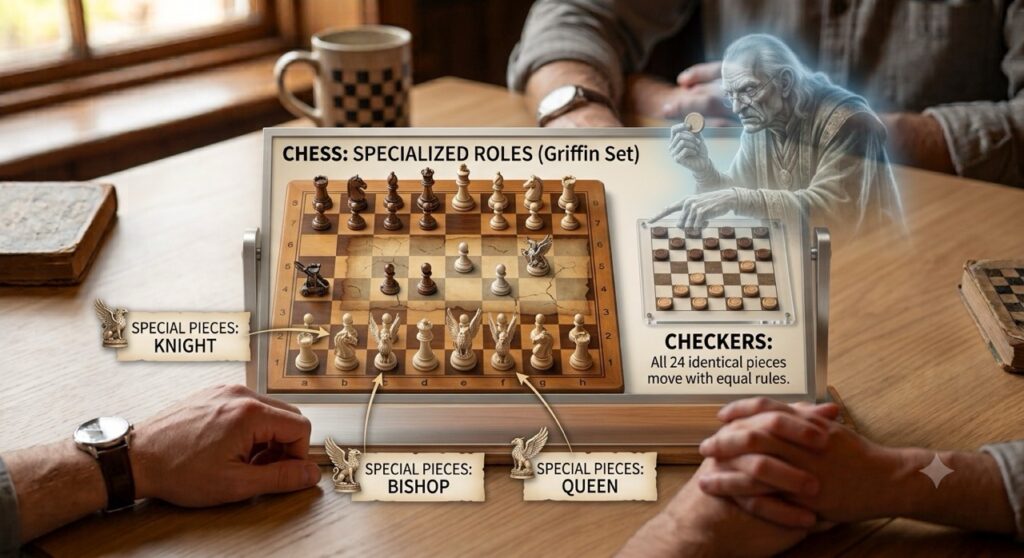
Most strategy games feature a hierarchy of pieces: units with vast reach, special jumping abilities, or high value that can single-handedly turn the tide of a match. Checkers offers no such safety net. Every single checker on the board moves at the exact same diagonal pace: one square at a time, strictly forward, until it reaches the final row.
This uniform movement speed establishes total spatial equality across the board, which teaches three fundamental lessons:
- Zero Dependency on Heavy Material: You cannot rely on a high-value piece to launch a sudden counter-offensive or rescue a collapsing position.
- Micro-Positional Sensitivity: Because every piece has identical mobility, position is everything. A single checker sitting on an incorrect square can cripple your entire defensive line.
- Uniform Speed Calculation: With every piece moving at the exact same rate, calculating tempo (the measurement of time and distance across the board) becomes purely mathematical.
When every piece is equal, victory belongs entirely to the player who coordinates their units into structured, mutually supporting formations.
How Multi-Jump Traps Work: The Math of Sacrifice
Sacrificing material is a common theme in board games, but in checkers, sacrifices are rarely about positional intuition: they are grounded in precise spatial mathematics. Because captures are mandatory, a sacrifice is a guaranteed trigger.
Executing a successful 2-for-1 or 3-for-1 multi-jump trap requires calculating multi-step chains under absolute constraint:
- Your Bait Piece Offered: You deliberately advance a checker into a vulnerable position, offering a single-piece capture.
- Opponent Forced Jump: Your opponent executes the mandatory capture, landing their piece on a specific, predetermined square.
- Trapped Square Target: That predetermined square aligns your opponent’s piece directly into a multi-jump line.
- Your Multi-Jump Counter-Strike: Your waiting checker or King sweeps the board to execute the decisive counter-strike.
Mastering these setups conditions you to view material not as static value, but as dynamic energy. Giving up a piece to control the exact landing spot of an opponent’s unit is the ultimate demonstration of board control.
Board Control and the Checkers Blockade Strategy
Winning a game of checkers does not require taking every single piece off the board. An equally decisive victory occurs when your opponent has pieces remaining but zero legal moves available. This tactical state, often referred to as “the cramp” or a total blockade, highlights a deep layer of spatial control.
Building a complete blockade teaches essential lessons in space denial:
- Edge Pinning: Drawing the opposing pieces to positions near the edges of the board where their freedom of movement is restricted by half along the diagonals.
- Center Dominance: Seizing the strategic central spots (14, 15, 18, and 19) to build a wedge that separates the opponent’s pieces into isolated and motionless pockets.
- Lane Suffocation: Methodically pushing forward tandem pairs of pieces to lock off the forward diagonals and immobilize the opponent’s front line.
Recognizing the patterns of blockades changes your perspective from piece destruction to space control. Checkers Rules are important to understand because only then you can use your strategy.
Checkers Opening Mistakes and Endgame Margins
Due to the consistency in move speed and compulsory captures, checkers has one of the lowest margins of error in the early stages and mid-game. In games where there is diversity in the movements of the pieces, an incorrect move can be offset tactically by playing defensively.
In checkers, a wrong positional move at the start (such as splitting up the King’s row too early or staying too close to the side board) leaves the player vulnerable to an enforced victory.
| Strategy Phase | Strategic Objective | Consequence of Miscalculation |
| Opening (Moves 1–5) | Maintain center control and keep back-row integrity intact. | Creates immediate weakness, triggering forced multi-jump traps. |
| Midgame | Advance in supported tandem pairs; control central diagonals. | Allows the opponent to establish a total blockade or “cramp.” |
| Endgame | Crown Kings and control the main long diagonal. | Positional blunders lead to a mathematically forced, unrecoverable loss. |
This extreme precision instills a high level of calculating discipline. It forces you to verify the structural integrity of your position before committing to an advance.
Tactical Disciplines
The table below highlights the core strategic skills cultivated through dedicated play:
| Core Mechanic | Strategic Discipline Developed | Mental Habit Formed |
| Compulsory Captures | Forced sequence calculation | Dictating opponent choices 2–3 moves ahead |
| Uniform Movement | Strict spatial tempo & formation control | Eliminating reliance on individual piece strength |
| Multi-Jump Traps | Material-for-position calculation | Utilizing deliberate sacrifices to control space |
| Blockades / Constraints | Space denial and mobility restriction | Focusing on limiting options rather than raw attrition |
Mastering checkers requires respecting its unforgiving nature. While casual players see a race to the back row, high-level play demands strict spatial discipline, forward planning, and emotional control.
By avoiding early edge traps, controlling the center, protecting your back row, and mastering forced-jump calculations, you instantly gain a decisive edge over most opponents. Every move carries binding consequences. Understanding what checkers teaches you that chess doesn’t gives you a deep appreciation for forced sequences and tempo, building a sharper tactical mind for any strategy game.