
The iGaming market in 2026 is being shaped by more than game selection. Regulation, mobile performance, payment speed, search visibility and player retention now determine whether an operator can grow profitably. Marketing teams also compare traditional acquisition with black hat seo services, although aggressive tactics can create ranking losses and reputational damage. Sustainable growth depends on combining product quality, compliance and marketing in one system.
What Is Driving the iGaming Market?
The industry continues to benefit from wider smartphone use, faster digital payments and the expansion of regulated gambling. At the same time, launching in a new country has become more expensive. Operators must localize KYC checks, cashier options, bonuses, support and advertising rules for every market.
European online gambling revenue was estimated at €47.9 billion in 2024, with casino and sports betting accounting for most of the total. The size of the sector attracts new brands, but it also raises the cost of acquiring verified depositors.
| Market factor | Effect on operators | Likely outcome |
| Local licensing | Separate legal and technical requirements | More country-specific platforms |
| Mobile growth | Demand for faster interfaces | Greater investment in mobile UX |
| Payment innovation | Pressure for quick deposits and withdrawals | Wider use of local methods |
| Higher traffic costs | Lower value from one-time users | Stronger retention strategies |
| Safer gambling rules | More checks across the player journey | Compliance built into product design |
The Impact of Changing Regulations
Regulation now affects the full customer journey. Operators must consider financial limits, identity verification, marketing consent and ongoing risk monitoring before a user reaches the game lobby.
In several mature markets, responsible-gambling tools are becoming mandatory parts of onboarding. This means legal and product teams must work together from the start. Adding compliance features after launch often creates broken flows, abandoned registrations and extra support work. The challenge is balance. Too many checks can frustrate legitimate players, while weak controls increase the risk of fines and licensing restrictions.
The Growth of New Regional Markets
Brazil shows how a large market can open under strict conditions. Authorized brands must meet local licensing, technical and domain requirements before accepting players. Similar patterns are appearing elsewhere: growth is available, but only to operators willing to localize properly. The main regional trends are:
- Brazil rewards licensed operators with Portuguese content and familiar local payment methods.
- Mature European markets require stronger compliance systems and tighter bonus controls.
- African markets favor lightweight mobile products that work on slower connections.
- Asian and Latin American regions need local sports coverage, wallets and support formats.
For companies building organic visibility, https://seo-rockets.com/ may fit into a wider SEO and localization strategy. Search traffic, however, cannot compensate for weak payments or poor retention.
Key Technological Trends in iGaming
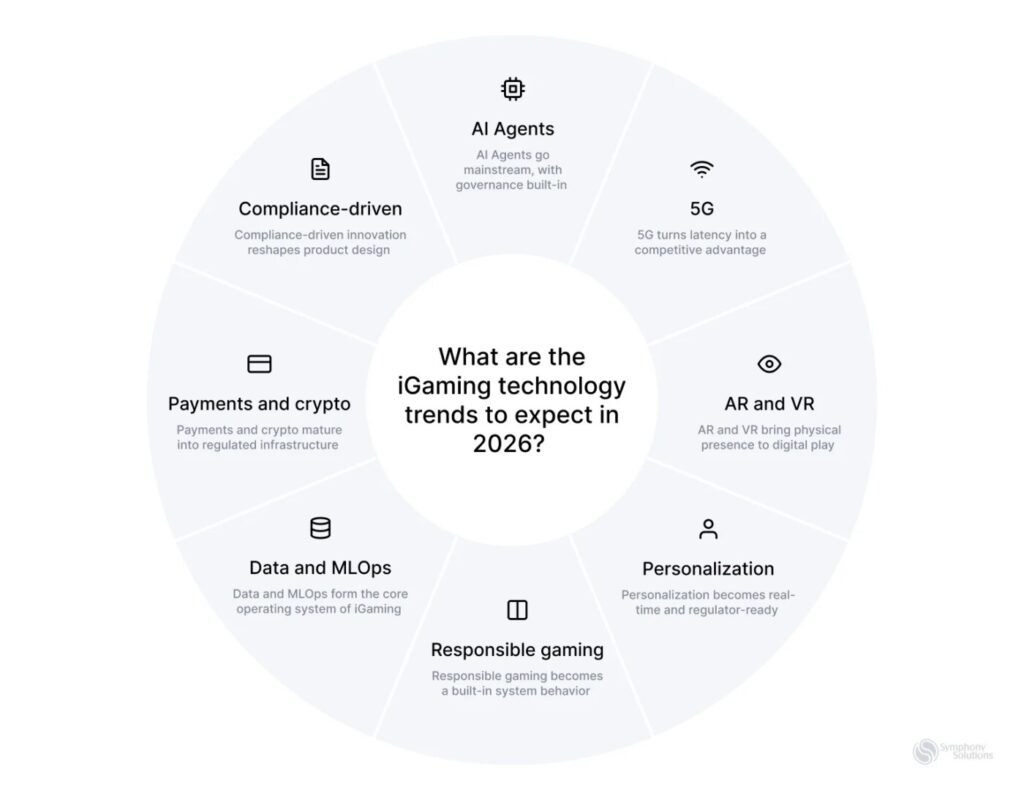
Technology spending is moving away from cosmetic redesigns. Operators now focus on stable cashiers, fast verification and lobbies that load quickly during traffic peaks. A delay of only a few seconds can reduce conversion. Players who face repeated redirects or failed payments can switch to another platform immediately.
The Shift to Mobile and PWA Apps
Mobile devices already generate most online gambling activity in many markets. This makes desktop-first design increasingly outdated.
Progressive Web Apps are becoming more attractive because they can be opened through a browser, added to a home screen and used without a traditional app-store download. They are especially useful in markets where store approval is slow or restricted.
The best mobile products remain simple. Clear balances, fast login, responsive search and a cashier without unnecessary steps usually matter more than heavy animation.
Crypto Payments and Blockchain Integration
Cryptocurrency remains relevant where players value fast transfers and cross-border settlement. Its role is becoming more controlled because operators must consider wallet screening, source-of-funds checks, volatility and local restrictions. Players expect transparent network fees and realistic withdrawal times.
A platform that advertises instant crypto transfers but delays every payout for manual review removes the main benefit of the method. Blockchain also has practical uses beyond payments. It can support transaction verification and transparent game mechanics, but it works best as infrastructure rather than a marketing label.
Changes in Affiliate Marketing Strategies
Affiliate marketing is shifting from registration volume toward player quality. Operators increasingly study KYC completion, repeat deposits, chargebacks and long-term activity before judging a campaign. A high CPA deal may bring quick traffic, but it does not guarantee profitable customers. This is why revenue-sharing and hybrid models are becoming more important.
Moving from CPA to Long-Term RevShare Models
RevShare agreements give affiliates a percentage of the revenue generated by referred players. Income grows more slowly than under a fixed CPA model, but retained users can create recurring earnings. Strong partnerships usually include:
- Landing pages built for a specific language and country.
- Clear rules for qualified users and negative carryover.
- Separate tracking for SEO, social and paid channels.
- Regular analysis of retention instead of registration totals.
- Compliance checks for bonuses and promotional claims.
Professional affiliate sites are therefore becoming independent products. Many now use databases, filters, calculators and detailed guides instead of publishing short generic reviews.
The Rise of Parasite SEO and Social Traffic
Parasite SEO became popular because third-party domains could rank faster than new websites. The method is less reliable now as search engines target content published mainly to exploit another domain’s authority.
Affiliates are diversifying into short-form video, messaging communities and sports-focused social pages. Social traffic can be unstable, but it helps publishers build audiences that are not fully dependent on search updates. The strongest approach combines owned websites, direct audience access and carefully selected external placements.
Player Retention and Product Innovation
Retention is replacing raw acquisition as the central profitability metric. Operators now measure how many users complete verification, return after the first deposit and use more than one product. A smaller group of loyal users can be more valuable than a large volume of one-time registrations. This changes how brands design bonuses, CRM campaigns and loyalty systems.
AI Tools for Personalization and Retention
Artificial intelligence is being used to rank games, predict churn, time messages and detect unusual payment behavior. It can make a lobby more relevant by showing content based on previous activity.
AI also supports safer-gambling systems. Algorithms can identify changes in session length, deposit frequency and spending. These signals may trigger account reviews or responsible-gambling interventions.
The main concern is how the data is used. A system should not detect risky behavior only to encourage another deposit. Human oversight and clear internal rules remain essential.
The Popularity of Fast-Paced Crash Games
Crash games fit mobile habits because rounds are short and the rules are simple. A multiplier rises until the round ends, while players decide when to cash out. Their speed supports frequent play, which creates both commercial potential and regulatory concern. Operators need visible histories, spending limits and session controls. Developers are also adding tournaments and social features. These additions can improve engagement, but transparent rules and stable performance remain more important than visual complexity.
Future Challenges for iGaming Brands
iGaming brands will face stricter compliance rules, higher traffic costs and growing competition in 2026. Success will depend on efficient player verification, responsible gambling tools, reliable payments and stronger retention. Operators that combine legal compliance with fast mobile products and transparent service will be better positioned to grow.
Stricter Compliance and Responsible Gambling Rules
Compliance costs are likely to rise as regulators demand stronger identity checks, payment monitoring and intervention records. The main priorities are:
- Add financial and session limits to account settings.
- Record marketing consent separately for each market.
- Monitor suspicious payments without blocking normal withdrawals.
- Train support teams to recognize risky behavior.
- Audit affiliates, payment providers and software suppliers.
These measures increase development costs, but they also reduce the risk of fines, lost licenses and rushed technical changes.
Rising Costs of Traffic and High Competition
Paid search, sponsorships and affiliate placements are becoming more expensive. Privacy restrictions also make attribution harder. This exposes weak business models quickly. A large welcome bonus cannot fix slow withdrawals, poor localization or an unreliable mobile platform. Operators need to understand lifetime value before increasing acquisition budgets.
Large companies can spread technology and compliance costs across several markets. Smaller brands need a clear niche, such as regional sports coverage, faster payments or specialist casino content. The iGaming businesses most likely to succeed in 2026 will not simply advertise more. They will choose markets carefully, build fast mobile products, process payments transparently and use player data responsibly.