
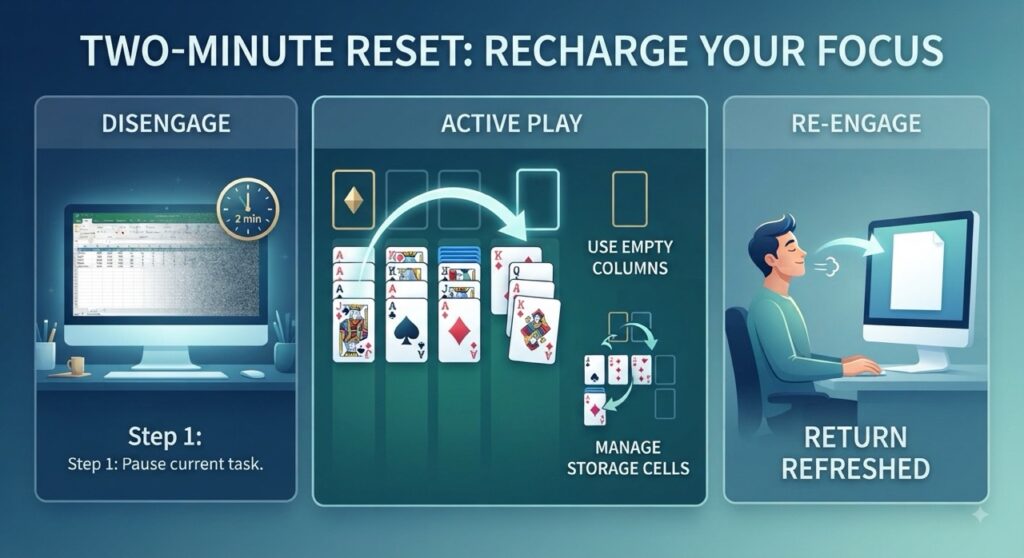
 Today’s working day is one of non-stop pings on Slack channels, meetings back-to-back, important emails, and constant changes of context, which deplete your cognitive energy before even having a lunch break. Once your brain reaches its limit, the usual reaction is to pick up your smartphone and aimlessly go through social media posts, an action which usually turns out to be thirty minutes of procrastination.
Rather than succumbing to the whims of the algorithm, dedicating some time for playing a quick digital card game becomes a perfect method of a two-minute brain reset in between assignments. For people who work remotely, for office workers, as well as students carrying huge loads of assignments, it is a perfect solution without taking too much time.
Understanding the Science of Cognitive Fatigue and Micro-Breaks
Have you ever switched from a complex spreadsheet to a blank word document, only to stare blankly at the screen for five minutes? That is attention residue in action. Your prefrontal cortex remains stubbornly tethered to the previous problem, causing cognitive drag, decision fatigue, and plummeting output.
The Palette Cleanser for Your Prefrontal Cortex
Introducing a break purposefully into your routine stops the mental bleed. This can be likened to interval training, whereby muscles need some rest after a set of intense activity for clearing out the accumulated lactic acid. The brain also needs some break time in order to maintain its peak functioning ability. Going past your limit without a break results in reduced productivity.
A tiny cognitive buffer lets your neural pathways reset. It strips away the friction of pivoting to a fresh project, giving you a clean slate. Once you close out that quick session, you are ready to tackle your next obligation with sharp clarity. (And if you happen to prefer group downtime once your shift officially ends, unwinding with friends over card games for 3 people makes a great offline alternative.)
Active Engagement vs Passive Scrolling for Mental Recovery
When people talk about taking a break, they usually default to passive consumption—scrolling through endless news feeds, watching algorithmic video clips, or skimming timelines. Unfortunately, passive scrolling doesn’t actually rest your brain. Instead, it floods your mind with a chaotic stream of unstructured information, triggering quiet anxiety and making it twice as hard to re-engage with professional tasks.
Why Interactive Logic Beats Mindless Consumption
By contrast, playing a freecell puzzle demands active engagement. It requires just enough visual tracking and tactical logic to occupy your working memory completely. Because every single card is exposed right from the opening deal, there is zero hidden information and zero reliance on luck.
This clean, structured problem-solving elbows out lingering work stress and office anxiety without frying your nervous system on high-stakes stimuli. Unlike a bottomless social media feed, a quick card layout has a definitive endpoint, giving your brain a satisfying dopamine hit of completion before you slide right back to work. Of course, once you master the classic version, you can always test your adaptability against intricate variants like Baker’s Game.
Keeping Sessions Short with a Quick Game Focus Reset
The biggest danger of taking a break during work hours is losing track of time. Traditional video games or browsing sessions easily balloon past your intended limit. FreeCell bypasses this trap entirely through its built-in pacing.
The Power of Built-In Time Boundaries
An experienced player typically wraps up a standard deal in roughly 120 seconds. This natural boundary acts as an organic kitchen timer for your brain. By enforcing a strict personal rule, such as closing the browser tab the exact second your final card flies up to the foundation pile, you keep your break tightly contained.
This predictability makes it infinitely superior to open-ended entertainment. You control the experience rather than letting the experience control you. Keeping your window compact ensures your break functions as a sharp productivity tool rather than an accidental time sink that wrecks your afternoon momentum.
Long-Term Cognitive Perks of Daily Puzzle Breaks
Such small breaks, if used constructively, bring unexpected dividends over time. Working with spatial logic every day is a great exercise for developing skills in pattern recognition, working memory, and mental agility.
Building Sustained Mental Agility
When you look at an overloaded screen, make calculations to move multiple cards, and seek out weak spots, you can say that you are putting your mind through an agility test. Over weeks and months, these micro-pauses build up your overall cognitive endurance, helping you manage stress better and think on your feet. Ultimately, viewing a quick game as a strategic reset rather than a guilty pleasure changes how you handle daily fatigue, proving just as mentally rewarding as mapping out complex strategies in eight off solitaire.