
We live in the age of social networks and the virtual world, almost always having gadgets at hand in the form of various devices. And everything would be fine if these great inventions had not so quickly displaced from our lives the opportunity for self-development and the opportunity to “pump up” our brains. There is an opinion that board games can compete with the computer world for a share of our attention and give us more reasons for personal meetings, for our development and learning. In this article, we will talk about the relationship between board games and mathematics, board games and sports betting.
Sports betting, like board games, develops analytical thinking: the need to analyze statistics, team and player forms, which helps develop critical thinking. There are many sites in different countries: betting sites in Australia, betting sites in Germany, in the UK betting sites over at FIRST.com, which review bets and give recommendations on safe play and control of expenses. Such tips and recommendations are also applicable in board games.
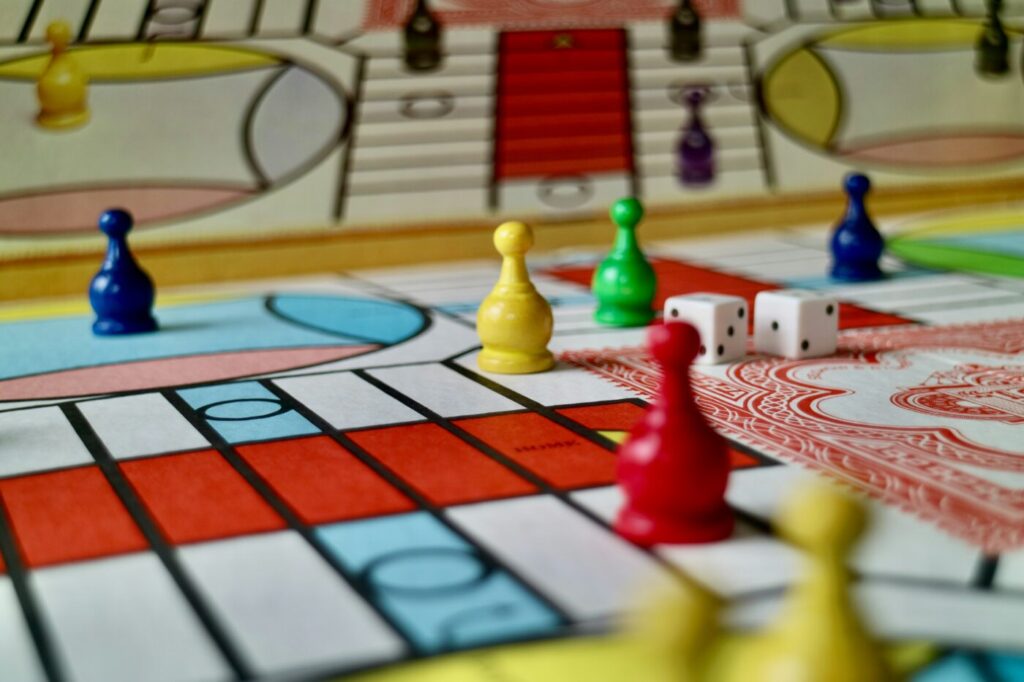
Counting moves, points, money, dots on two dice, cards with resources for building a village – this is what even preschoolers do casually in the game. Almost all games require at least arithmetic calculation of the winner. There are board games with a clear focus on mathematics: they can train logic (“Set”) or practice additional skills within a dozen or a hundred (“Zeus on Vacation”, “Sleeping Queens”).
Of course, board games should first and foremost entertain or simply bring some emotions. However, at present, this is far from their only function. A modern board game is a complex work with its own plot and game mechanics tied to it. If the game is really thought out, then everything that happens at the gaming table will be logical and understandable.
There are over 20 genres of board games, and some of them make players who want to win the next game think hard. In the vast majority of cases, the game should be moderately entertaining, and not just make you frantically think through your moves and follow your opponents’ actions. If all the games are too complicated, then they will not suit the mass buyer who wants to relax, forgetting about solving the next difficult problems.
Moreover, it is possible to develop the ability to calculate even in a hand-drawn adventure game, say scientists from Boston College and Carnegie Mellon University. It is important how exactly the players move around the field: do they count from one or do they add the result to the already counted fields, thus performing increasingly complex mathematical operations.
In the game, actions have clear consequences, and these consequences are clearly reflected in your results. You have just turned a knight into a queen, thereby bringing down the yen exchange rate. The game provides a kind of closed environment in which, firstly, it is not scary to act, and secondly, cause-and-effect relationships are easily tracked even 20 minutes in advance. This allows you to think through moves ahead, try to predict the behavior of your opponent and learn from your own experience.
For example, critical and mathematical thinking is very important in a game like «Monopoly». The goal of the game is to use the starting capital rationally to remain the only player who has not gone bankrupt. This teaches you to use money more rationally, both in the game and in life.
Conclusion
In conclusion, board games, long considered a source of entertainment, have become a powerful tool for strengthening mental health. They have become not only an exciting way to pass the time, but also stimulate cognitive functions, including memory, mental flexibility, and emotional regulation.