
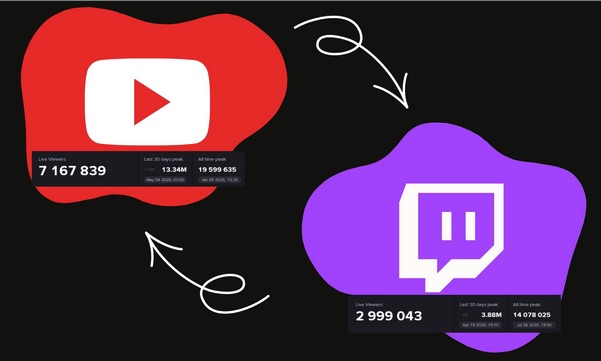
In early 2026, the market for gaming streaming platforms saw its most significant shift in several years. YouTube Gaming increased its market share by 15% in the first quarter of the year, while Twitch continued to lose viewers in North America and Western Europe. According to data from Streams Charts and SullyGnome, the average viewing time for esports streams on YouTube has risen significantly and is outpacing that of its competitors. In this article, we’ll explore whether YouTube Gaming really is better than Twitch and why it’s gaining popularity.
Why Did YouTube Gaming Gain Market Share So Fast In Q1 2026?
Screenshot
To begin with, it is worth understanding what is driving the rapid growth of YouTube Gaming. According to experts, this is largely due to the platform’s focus on major exclusive streams and a video service that many viewers find more convenient to use. In 2026, ESL expanded its partnership with YouTube, adding several major Counter-Strike 2 events to the platform’s English-language streams, which helped attract more viewers. Part of the audience switched to YouTube not only for the tournaments themselves, but also for easier access to match replays — in this area, Twitch still lags behind its competitor. More information about tournament broadcasts is available on the official ESL FACEIT Group page.
Meanwhile, analysts at Streams Charts noted that the average viewer retention time on YouTube Gaming in March 2026 increased by approximately 11% compared to the fourth quarter of 2025. This is particularly noticeable in streams of major Dota 2 and CS2 events, which can be followed on Liquipedia and HLTV.org.
In addition to esports, the overall popularity of video games is also on the rise. Many users who follow video game industry updates have noticed an improvement in content quality specifically on YouTube Gaming. Content creators are focusing not only on tournament results, but also on how to improve the platform and what will engage viewers. The shift of part of the audience to YouTube is already affecting the advertising budgets of organisations and media companies.
How Is Twitch Losing Its Position Against YouTube Gaming?
Twitch remains the largest streaming platform in terms of the number of channels. However, data collected for the first quarter of 2026 suggests that a significant portion of the audience is beginning to switch to alternative platforms. This is particularly true for esports broadcasts, where YouTube is performing better thanks to its stable video player and 4K support.
Following the redundancies at Amazon in 2025, Twitch began to cut costs more aggressively. This affected support for affiliate programmes and local events. In January 2026, several well-known streamers, including Ludwig and DrLupo, criticised the platform’s unstable revenue system.
Twitch is also becoming less attractive to esports tournament organisers than it once was. According to data from Streamscharts and similar platforms, although Twitch remains the primary platform for tournament broadcasts, organisers are now paying more attention to SEO, long-term video storage and visibility in Google search results. In these areas, YouTube generally performs better.
A shift in behaviour among younger audiences is also being observed on Twitch. Users aged 16 to 24 are watching live streams without additional content less and less. They are switching between Shorts, TikTok clips and full-length streams. YouTube has managed to combine these formats into a single system, while Twitch remains a platform that is largely based on live content.
Games and esports events that have contributed to the growth of YouTube Gaming
Screenshot
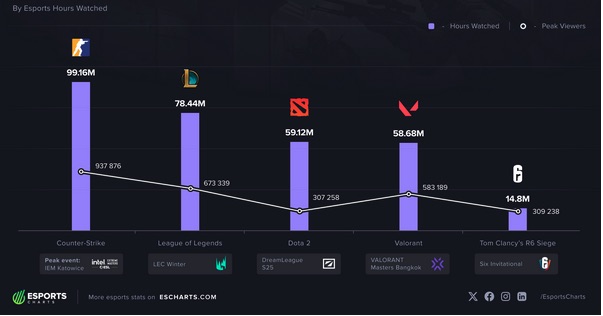
Counter-Strike 2, Dota 2 and mobile esports made the biggest contribution to YouTube Gaming’s growth. According to Streams Charts, CS2 was one of the main sources of new audiences in the first quarter of 2026. BLAST and ESL tournaments consistently attracted hundreds of thousands of concurrent viewers on YouTube, specifically during matches involving FaZe Clan, Vitality and NAVI.
Valorant has also strengthened its position in the esports rankings on YouTube. During VALORANT Masters Santiago 2026 in March 2026, the English-language stream on YouTube surpassed Twitch’s figures in several regions simultaneously.
The mobile segment, which is currently growing at a very rapid pace, deserves a special mention. The well-known MLBB and PUBG Mobile continue to attract a huge audience in South-East Asia, where YouTube traditionally dominates. Twitch has historically been weaker in these regions due to a smaller local presence and poorer adaptation for mobile users.
The importance of YouTube’s recommendation algorithms should not be overlooked. If a user watches a single CS2 match or a Dota 2 highlight, the platform automatically begins recommending full streams, interviews and clips. This creates a continuous viewing cycle. In this respect, Twitch relies primarily on existing subscriptions.
Analysts also note a shift in the advertising market. Well-known brands are more willing to invest in advertising campaigns on YouTube due to the longer lifespan of content. Whilst a Twitch stream generates most of its traffic only during the live broadcast, YouTube videos can accumulate views for months. This is significantly more profitable for brands.
What Could Happen To Streaming Platforms By The End Of 2026?
The current trend does not mean that Twitch will lose its status this year, but the outlook for Amazon looks worrying. If YouTube Gaming maintains its growth rate for a few more quarters in a row, the advertising market will begin to shift budgets between platforms even more rapidly.
Newzoo analysts predict that by 2026, the esports audience will exceed 640 million people, and the proportion of mobile gamers will also increase. YouTube is successfully adapting to new formats, whilst Twitch is still trying to preserve the old model of content consumption.
It is also worth considering the impact of artificial intelligence on recommendation systems. YouTube is actively testing AI-generated clips and the generation of highlights from streams. This allows creators to share content more quickly without the need for separate editing. Twitch is developing more slowly in this area.
In addition, the behaviour of streamers is changing. Previously, they focused on a single platform, but now they are increasing their presence on YouTube, TikTok and Kick. Content has become more fragmented, which works in favour of platforms with strong recommendation algorithms.
In addition, streamers’ behaviour is changing. Previously, content creators focused on a single platform, but now they stream simultaneously on YouTube, TikTok and Kick. Content has become more fragmented, which works to the advantage of platforms with strong recommendation algorithms.
Conclusion
The first quarter of 2026 showed that the streaming platform market is currently undergoing a transformation. YouTube Gaming has captured around 15% of Twitch’s market share thanks to better integration of video content, the performance of its algorithms, and partnerships with major tournament organisers.
For Twitch, the situation is becoming more challenging due to issues with marketing, monetisation and poor promotion of content outside of live streams. If the company does not change its approach to platform development, this gap could widen even further by the end of 2026. The main battle is now being fought not only for streamers, but also for control over the entire cycle of gaming content consumption, from short clips to the finals of major tournaments.