
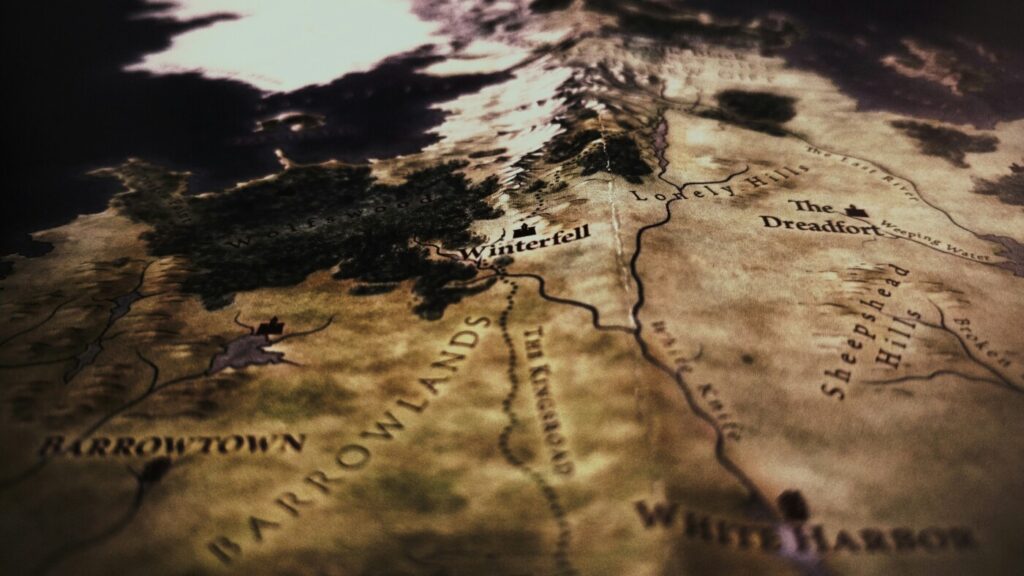
Some say it’s obvious. Some are not so sure. But ever since Game of Thrones became an international TV megahit, fans have debated over how much George R.R. Martin was influenced by his love of tabletop games, and whether or not the world of Westeros started as a role-playing campaign intended for RPG devotees.
Martin has distanced himself from the connection. He told The Guardian in 2018 that his original concept was a short story. In hindsight, that seems incredible given the epic scale of the novels he would go on to write. The first words put to paper concerned a family discovering a group of dire wolf pups. Game of Thrones began to develop when Martin began exploring the lives of the different families involved. That was when the “world started coming alive,” says the author.
Yet, despite Martin’s denials, it’s hard not to see why many fans believe Game of Thrones is a tabletop RPG in novel and, eventually, TV form. The author has admitted he has huge admiration for such games, telling journalists he was a hardcore RPG nerd in the 1980s. The immersive nature of these role-playing systems would inevitably shape his understanding of story structure, world-building, and character design.
The Impact of GURPS
Principally, Martin favoured the mechanics of Steve Jackson’s GURPS, which was first released in 1986. It championed real human flaws instead of fantastical superpowers, social status and political hierarchies, and the logistics of warfare like geographical hurdles, travel time, and food supplies. Alongside the author’s experience of playing a variety of titles with his Albuquerque gaming group, Game of Thrones’ world-building became something of a sandbox for Martin. He set the rules, a bit like the games he was accustomed to, and allowed his characters’ stories to play out naturally, their destinies determined by the choices they make.
Ultimately, this is what formed the foundations for one of the most successful IPs of the modern era. Thanks to its multi-award-winning TV adaptation, it has spawned small-screen spin-offs like House of the Dragon and popular UK slots online titles like Microgaming’s 5-reel game that recreates the Seven Kingdoms with familiar characters and locations captured on its symbols. Phrases like “winter is coming” have entered casual conversation, Arya has become a popular baby name, and millions of pounds continue to pour into Northern Ireland as visitors from all over the world visit the TV series’ filming locations.
Martin has argued that he’s previously acknowledged adapting some RPG titles into fiction – such as with his Wild Cards book series – so why wouldn’t he admit to the tabletop game connection with Game of Thrones? He’s also referenced the 15th-century English civil war between the Lancasters and the Yorks as inspiration, suggesting real-world history guided his writing. But it’s clear why fans still go back to his admiration for RPGs.
Telltale Signs
Many point to the unpredictability of Martin’s creation. Examples such as how a hero-like king can be taken out by a single wild boar or a seemingly invincible warlord can succumb to a minor chest wound are highlighted because they feel like the rulesets you’d find in GURPS.
In such RPG systems, characters don’t possess abstract hit points to save them; they’re bound by physics and their own flaws. Instead of convenient miracles, we get the catastrophic consequences of the character’s poor choice. In Martin’s world, the remaining “players” scramble for command of the power vacuum left behind. That’s why, for those who love their role-playing adventures, Game of Thrones feels very familiar.