
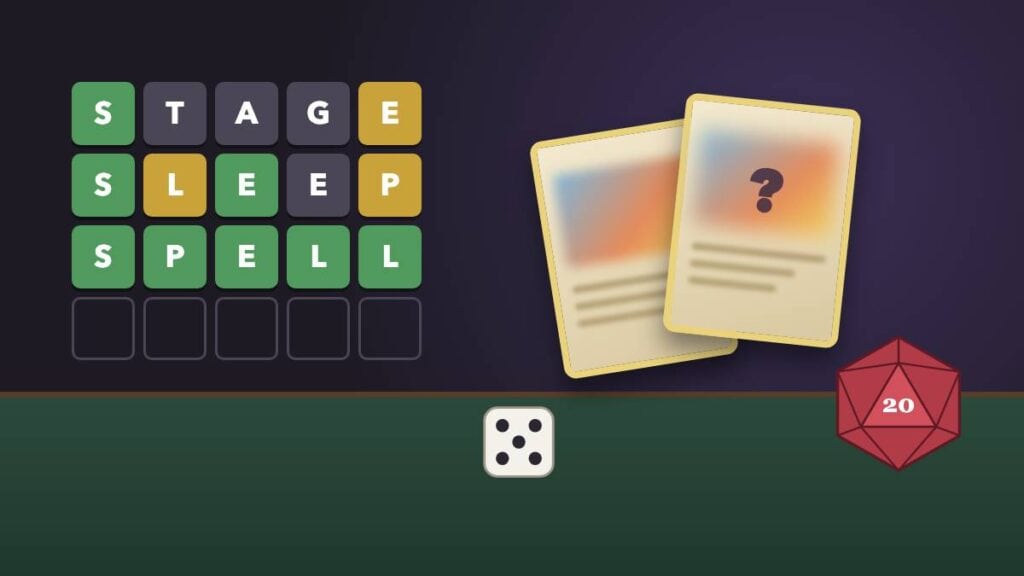
Wordle did something odd to the internet in early 2022. One five-letter word a day, the same word for everybody, and within weeks half your friends were posting little grids of green and yellow squares. The craze faded, but the format didn’t. It spread into every hobby with a big enough library of things to guess, and tabletop gaming was a natural fit. We’ve got monster stat blocks, three decades of Magic cards and thousands of Pokémon printings, all documented in loving detail.
These games are built for a lunch break. You get one round a day, it takes a few minutes, and you can’t binge it, so it never swallows an afternoon you’d planned to spend painting minis. Here are five worth bookmarking if your weekends involve a DM screen or a deck box.
DNDle: guess the monster from its stats
DNDle is the one most D&D players should start with. You aren’t guessing letters here. You’re guessing ability scores. Each day there’s a hidden creature from the fifth edition rules, you enter a spread of six stats, and the game tells you which numbers are right, which ones are right but in the wrong slot, and which are wrong altogether. You get eight attempts.
It’s a sneakily good test of how well you know a stat block. Anyone who’s run a few campaigns will know that a towering Strength score next to a miserable Intelligence points one way, while high Wisdom and Charisma point somewhere else entirely. The whole thing runs in your browser, the code is open source, and it works offline once it’s loaded.
Spellify: name the Magic card from what’s left of it
Magic players have Spellify, which started life on Commander’s Herald and is now hosted by EDHREC. You’re shown a random card with its name hidden and its art, rules text and mana cost obscured, and you work out the name hangman style, letter by letter. You get 13 guesses. That sounds generous until you remember how many cards share a colour and a creature type. Hard mode takes away even more, including the colour and card type.
It rewards the kind of knowledge you only pick up from years of opening packs and building decks, not from studying a list.
Cardle: the Pokémon card version
Cardle is ours, so read this section with that in mind. It’s a daily guessing game on CardTrack, a site that tracks trading card prices, and the mystery each day is a real Pokémon card rather than a Pokémon. The card starts heavily blurred and gets sharper with every guess. Each guess tells you whether you’ve got the right set, and whether the answer is higher or lower by National Pokédex number and by market value. You get six tries.
The value clue is what makes it different. Every card in the pool is one of the 600 most valuable cards CardTrack tracks within a range of $20 to $4,000, so the answers lean towards cards people actually chase. If you’ve got a rough feel for what an old holo is worth next to a modern full art, that instinct suddenly becomes useful. Everyone gets the same card each day, there’s a practice mode for when one round isn’t enough, and your streak is saved in your browser.
Pokédle and Squirdle: for the Pokémon themselves
If you’d rather guess the creature than the card, Pokédle and Squirdle both hide a Pokémon for you to find. Pokédle compares each guess with the answer on type, generation, colour, evolution stage, height, weight and habitat, with arrows telling you to go higher or lower. It also has separate modes built around silhouettes, cries and blurred cards. Squirdle is the older of the two. It works on a similar idea, with hints on generation, type and size, and gives you eight chances in its daily mode.
Both are a gentle way into the format for younger players at the table.
Why they suit people who play at the table
Strip away the theme and these games are about deduction, the same habit you use when narrowing down a monster’s resistances mid-fight or counting what’s still left in an opponent’s deck. Each guess hands you partial information, and the skill is picking the next guess that rules out the most options.
They’re social too, in a low-effort way. The share grids that made Wordle famous work just as well in your party’s group chat or your local game store’s Discord. A round takes about as long as a cup of coffee.
Getting the most out of them
Try not to look anything up halfway through. Stat blocks and card databases are a click away, and checking them kills the fun. If your group meets on a set night, it’s worth picking one game and posting everyone’s results that afternoon. It gives people something to argue about before the first initiative roll.
All five are free and run in a normal web browser. DNDle and Spellify will suit the D&D and Magic crowd best, while Cardle, Pokédle and Squirdle cover the Pokémon side of the hobby.