
Quick Overview of Fire Watch Compliance
|
The unexpected failure of a fire alarm system or a malfunction in a sprinkler system can result in unexpected problems. A defrosted pipe, a malfunction of a pressure gauge, and failure of the central control panel may turn the previously functional building into a building that violates the fire safety code. Whenever the monitoring systems go offline, the owners of the property must ensure that the safety precautions are implemented and organized in the building, since otherwise, the owners will have to evacuate the residents of it.
Fire marshals will not take a “pardon” attitude towards property owners even when they are waiting for the repair team to fix the issue. According to the fire safety regulations, it is prohibited to have automatic detection systems out of operation without arrangement of proper active monitoring. Setting up reliable Fire Watch Security guarantees that the facility operates well and meets all fire safety requirements at the local and national levels during the repairs.
Gaining knowledge about the basics of procedures and protocols related to the organization of patrols enables the property owner to deal with the downtime of the equipment without incurring penalties or suspending the operation of a building.
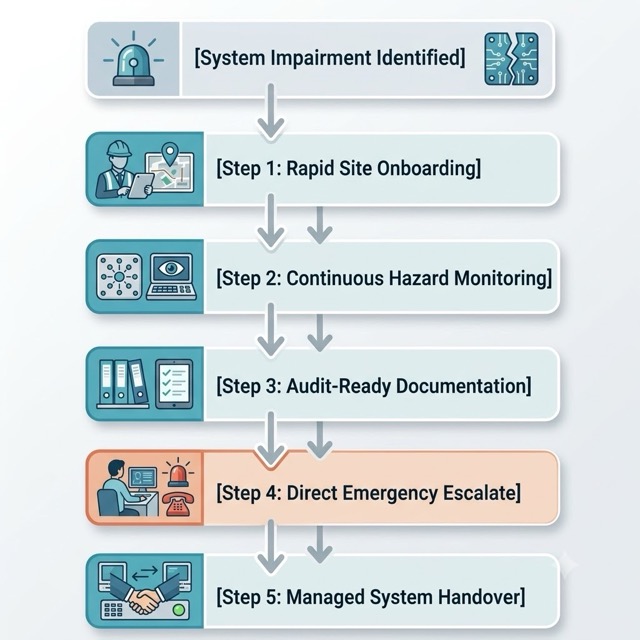
1. Rapid Site Assessment and Customized Patrol Routing
Building operators must act instantly when the fire suppression system fails. Fire marshals typically allow for only a few hours after the failure is reported to place guards at the site.
The first part of the process is to map out the building itself and remove any blind spots. Standard security measures do not suffice because guards can only look at the entrances and protect the property.
An effective fire watch starts with creating a patrol route aimed at high-risk areas:
- Mechanical rooms with main sprinkler risers and booster pump equipment
- Storage spaces filled with flammable materials
- Hot work zones where welding or other production activities can take place
- Stairwells, exit corridors, and emergency door releases
A good plan shows that inspectors will see a clear plan upon arriving at the site.
2. Continuous Ground Patrols for Active Hazard Detection
Electronic smoke detectors continuously scan their surroundings without requiring any rest. To ensure the constant vigilance is maintained with human beings, regulations, and a systematic course of action must be established through everyday patrol across the property premises.
While performing fire watch duties, guards will actively search for possible early indications of fire threats.
- Overheating Equipment: This is done by checking the control panels, motors, and temporary heating systems for any odd smells or warmth.
- Blocked Exits: The guards ensure that corridors, exit doors, and stairwells are not obstructed by rubbish, pallets, or any construction debris.
- Unsafe Storage: The guards pay attention to flammable liquids, rags, or other chemicals stored near the heating units or electrical panels.
- Damaged Fire Safety Equipment: The guards check that fire extinguishers are charged, accessible, and not blocked.
Hiring trained specialists from The Fast Fire Watch Company guarantees the implementation of patrols without interruptions, thus keeping your location safe and secured until the problem is resolved permanently.
3. Maintaining Audit-Ready Patrol Logs and Documentation
A fire watch plan depends on the level of record-keeping behind the plan. If an inspector comes to your location during the time when the system malfunctions and you can’t provide any records of patrols, you might still be fined for the violation of the rules.
According to national standards, including NFPA 25, an operator needs to keep records of all activities related to the fire watch activities. The logbook must consist of the following details for each patrol round that has been completed:
| [LOG ENTRY TEMPLATE]
Date: YYYY-MM-DD Guard Name / ID: ______________________ Patrol Round Start Time: HH:MM | End Time: HH:MM Areas Checked: [x] Riser Room [x] East Stairwell [x] Warehouse Floor Observed Hazards: None / Details: __________________________________ Guard Signature: ______________________ Timestamp: HH:MM |
Professional companies are now able to utilize GPS tracking devices which allow the operator to mark the rounds. Utilizing Fire Watch Security provides the operator with confidence in the legitimacy of the reports during inspections.
4. Establishing Direct Emergency Escalation Pathways
During a power failure, there is no chance to depend on the automatic alarm panel to inform the local authorities about any emergency. In case of a fire eruption, the immediate watch person will become the primary alerting system of the building in question.
An efficient watch protocol creates a direct channel of communication between the ground personnel, facility managers, and local fire departments.
- Immediate Alerting: The watchman detects the smoke or flame promptly and informs the local emergency authorities by phone as fast as possible.
- Facility Warning: Evacuation is started by the guard when the alarm is triggered using manual air horns, portable PA systems, or pull station overrides in case the emergency power is still available.
- Guiding First Responders: The guard meets the fire team that has arrived at the scene and provides them with site plans, keys, and information about the fire location.
Timely provision of this information in the beginning stages of the emergency allows you to avoid huge losses from a minor incident.
5. Seamless Transition and Handover Post-Repair
Completion of a fire watch assignment does not indicate that a technician has resolved an issue or repaired equipment. Leaving the job prematurely will mean that code violations may arise due to a lack of clearance from a fire marshal.
Proper closing involves three specific actions:
- System Verification: Certified technicians carry out a test to check the functionality of the alarm panel, flow switches, and central station.
- Official Clearance: The local authority or fire marshal goes through the repair records and patrol logs to file a report lifting the status of the impairment.
- Formal Deactivation: Management gives a signature at the end of the patrol report meaning that fire safety measures should be working properly.
Collaborating with professionals like The Fast Fire Watch Company allows for maintaining trained guards on the site until the sign-off and safeguarding the job.
Common Questions
When do you need to organize a fire watch?
Fire regulations require a fire watch if fire alarms or sprinklers are not operational for a period of more than four hours per day or for a period of time due to high hazard operations (hot work).
Can existing building staff do fire watch?
For certain rules, internal workers are permitted to take on fire watch duties if they are not allowed to do any other job. The employees taking the fire watch cannot help answer the phones or front desk while working or fix anything.
What information should be incorporated in the fire watch log?
The correct log should have the ability to contain dates and times of patrol rounds, names of the officers covering the rounds, check points, dangers, and measures taken to overcome them.
When do you need to start a fire watch following the system’s breakdown?
Most authorities recommend starting fire watch within 2 hours to 4 hours after detection of major security/communications systems failure so as to prevent shutting down the building.
How do brands specializing in fire watches ensure that standards are met?
Companies such as The Fast Fire Watch Company use trained guards, proper patrolling procedures, detailed logs, and round-the-clock dispatch to comply with local authorities’ fire marshal requirements.