
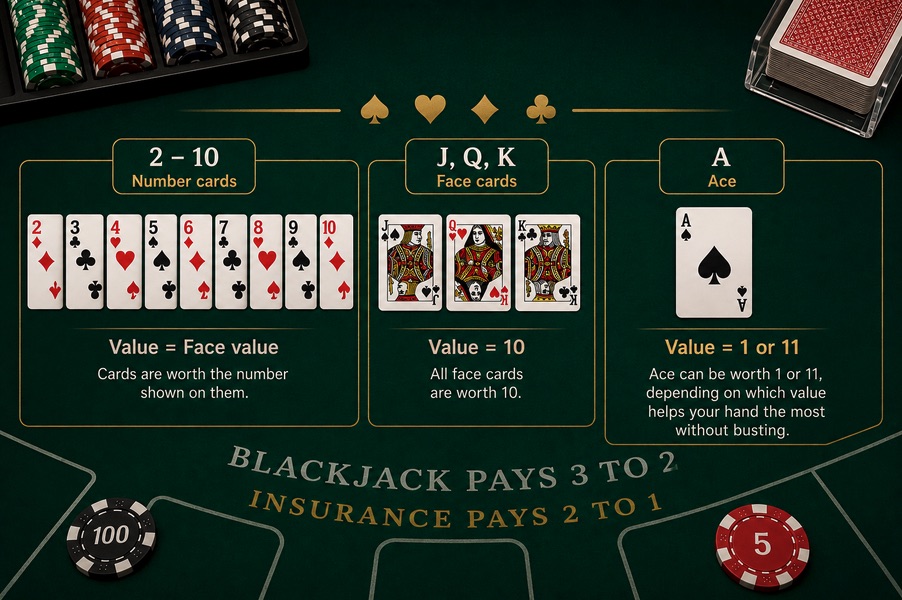
Screenshot
Whether you’re a first-time player sitting down at a felt table or a Dungeon Master designing a tavern scene where rogues gamble away their gold, understanding blackjack card values is the foundation of running the game well. Blackjack looks simple, twenty-one points and you win, but the nuance of how each card contributes is where strategy lives.
This visual guide breaks down every value, explains the famously flexible Ace, and shows how these mechanics translate into tabletop RPG sessions. By the end, you’ll have a clear grasp of the blackjack rules card values that govern every hand.
The Core Card Values Every Player Must Memorize
Before you can split, double down, or bluff a tavern keeper out of a magic item, you need to internalize the point value of every card in the deck. This section lays out the numerical hierarchy in the clearest possible terms, with a visual breakdown that’s easy to recall mid-game.
Here is the master reference table every new player should commit to memory:
| Card | Point Value | Frequency in Deck | Strategic Notes |
| 2–6 | Face value (2–6) | 20 cards | “Low” cards, favor the player when dealer must hit |
| 7–9 | Face value (7–9) | 12 cards | “Middle” cards, neutral influence |
| 10 | 10 | 4 cards | Part of the ten-value tier |
| Jack | 10 | 4 cards | Identical to a 10 |
| Queen | 10 | 4 cards | Identical to a 10 |
| King | 10 | 4 cards | Identical to a 10 |
| Ace | 1 or 11 | 4 cards | Flexible, creates “soft” hands |
Number Cards (2 Through 10): Face Value Is Everything
Number cards are the most intuitive part of blackjack and the easiest starting point for newcomers. A 2 of hearts is worth two points, a 7 of clubs is worth seven, and a 10 of diamonds is worth ten. Suits never affect value in blackjack, which is one of the rules that sets it apart from poker. If you’re new to the broader world of card-based gambling games and want a trusted starting point for learning the landscape of online play, Casino10.org curates region-specific recommendations so beginners can find safe, reputable platforms that match their location and playing style before risking real money on unfamiliar sites.
Quick facts about number cards:
- Suits (hearts, diamonds, clubs, spades) have zero impact on value.
- The 10 is the only number card that shares a value with face cards.
- Number cards 2 through 6 are statistically the dealer’s worst friend, because the dealer is forced to keep drawing on low totals.
Face Cards (Jack, Queen, King): The Silent Tens
Face cards often confuse new players who assume the Jack, Queen, and King carry escalating values like in poker or trick-taking games. In blackjack, all three are worth exactly ten points, no more, no less. This means roughly one-third of any standard deck is effectively a “ten card,” which dramatically shapes probability and strategy at the table.
Why face cards matter so much:
- There are 16 ten-value cards in a 52-card deck (four 10s plus twelve face cards).
- That works out to roughly 30.8% of the deck being worth ten.
- This density is why “assume the dealer’s hole card is a ten” is the single most useful mental shortcut in basic strategy.
The Ace: A Card That Bends the Rules
The Ace is the most strategically rich card in blackjack because it can be counted as either 1 or 11, depending on which value benefits your hand. A hand containing an Ace that can still be counted as 11 without busting is called a “soft hand,” while a hand where the Ace must count as 1 to avoid going over 21 is a “hard hand.” Mastering this duality is what separates casual players from confident ones.
How Card Values Translate to Winning Hand Totals
Knowing individual card values is only half the equation, the other half is understanding how those values combine into the hand totals that actually win money or bragging rights. This section walks through the math of common hand combinations and the magic number every player chases.
| Starting Hand | Total | Hand Type | Recommended Action |
| Ace + King | 21 | Natural Blackjack | Stand (instant win) |
| Ace + 6 | 7 or 17 | Soft 17 | Often hit |
| 10 + 7 | 17 | Hard 17 | Stand |
| 8 + 8 | 16 | Pair | Split |
| 10 + 6 | 16 | Hard 16 | Hit vs. high dealer card, stand vs. low |
| 5 + 5 | 10 | Pair | Double down, don’t split |
The Natural Blackjack: 21 in Two Cards
A “natural” or “blackjack” is the strongest possible opening hand and consists of an Ace paired with any ten-value card (10, Jack, Queen, or King). It pays out at a higher rate than a standard win at most tables, typically 3:2, and cannot be beaten, only tied. Recognizing this combination instantly is the first reflex every player should build.
Payout comparison at a glance:
- Standard win: 1:1 (bet $10, win $10)
- Natural blackjack at 3:2 table: $10 bet returns $15 profit
- Natural blackjack at 6:5 table: $10 bet returns only $12 profit, avoid these tables
Reading Hard Totals vs. Soft Totals
A hard total is any hand without an Ace, or one where the Ace must count as 1 to keep you under 22. A soft total is any hand where the Ace can still flexibly count as 11. The distinction matters enormously for strategy: a soft 17 (Ace + 6) is a much safer hand to hit on than a hard 17, because drawing a high card can’t bust you.
Key differences between hand types:
- Hard hands can bust with the next card if the total is 12 or higher.
- Soft hands cannot bust with a single additional card, the Ace simply drops to 1.
- Doubling down on soft 13 through soft 18 is a common advanced play against weak dealer upcards.
The Bust Threshold and Why 21 Matters
Any hand totaling 22 or more is an automatic loss, regardless of what the dealer is holding. This is why card values aren’t just numbers, they’re a running risk calculation. Every additional card you take is a gamble against the deck’s composition, and understanding the relative density of ten-value cards is what makes seasoned players hesitate or push forward.
Blackjack Card Values in the Wider Card-Game Universe
Blackjack doesn’t exist in isolation. Many players who enjoy 21 also dabble in poker, baccarat, and other classics, and understanding how card values shift between games sharpens your appreciation for each one. This section places blackjack in context with its closest cousins.
How the same card behaves across three popular games:
| Card | Blackjack | Poker | Baccarat |
| 2–9 | Face value | Lowest ranks | Face value |
| 10 | 10 points | Mid rank | 0 points |
| Jack/Queen/King | 10 points | High ranks | 0 points |
| Ace | 1 or 11 | High or low | 1 point |
Comparing Blackjack and Poker Card Values
In poker, card rank determines hand strength through combinations like pairs, straights, and flushes, rather than a numerical total. If you’d like a deeper look at how poker’s value system works alongside blackjack’s, this breakdown of poker hands and how to play them is a useful companion read. The contrast makes blackjack’s pure-arithmetic system feel refreshingly direct.
Major differences between the two games:
- Blackjack is a player-vs-dealer game, poker is player-vs-player.
- Blackjack values are fixed and numeric, poker values are relative and combinatorial.
- Blackjack has one winning target (21), poker has ten possible hand rankings.
The History of 21 and Standardized Card Values
Blackjack’s modern card values evolved from earlier European games like the Spanish “Veintiuna” and the French “Vingt-et-Un,” both meaning twenty-one. According to Encyclopedia Britannica’s overview of the game, blackjack as we know it spread through American gambling houses in the 19th century and was formalized into the ten-value face card system used universally today.
Milestones in blackjack’s evolution:
- 1600s: Earliest references to Veintiuna appear in Spanish literature.
- 1700s: Vingt-et-Un becomes popular in French casinos.
- 1800s: The game crosses the Atlantic and spreads through American saloons.
- 1931: Nevada legalizes gambling, standardizing modern blackjack rules.
A Visual Cheat Sheet for the Table
Sometimes a chart beats a paragraph. This section gives you a quick-reference layout you can mentally screenshot before any blackjack session, structured the way veteran players actually recall card values.
The three-tier mental model in table form:
| Tier | Cards | Value | Mental Color Cue |
| Low | 2, 3, 4, 5, 6 | 2–6 | Green |
| Middle | 7, 8, 9 | 7–9 | Yellow |
| High | 10, J, Q, K | 10 | Red |
| Wildcard | A | 1 or 11 | Purple |
Bringing Blackjack to the Dungeon Master’s Toolkit
For DMs, blackjack is a goldmine of in-world flavor. A tavern card game, a thieves’ guild gambling den, or a high-stakes duel with a devil over a soul, all become richer when the underlying mechanics are real and learnable by your players. This section shows how to weave authentic blackjack into your campaign.
Using Real Card Values in a Tavern Scene
Pull out an actual deck during a session and let your players play a hand of blackjack against an NPC for an in-world wager. The card values translate perfectly without any homebrewing, and the tension of a real draw beats any dice roll for atmosphere.
Converting Blackjack Mechanics to D20 Systems
If you’d rather keep dice in play, you can simulate blackjack by having players make successive d10 rolls (treating face cards as flat 10s) and decide when to stop. The Ace’s 1-or-11 flexibility can be represented by a charisma or insight check, adding a roleplay layer to a classic gambling mechanic that your table will remember long after the campaign ends.