
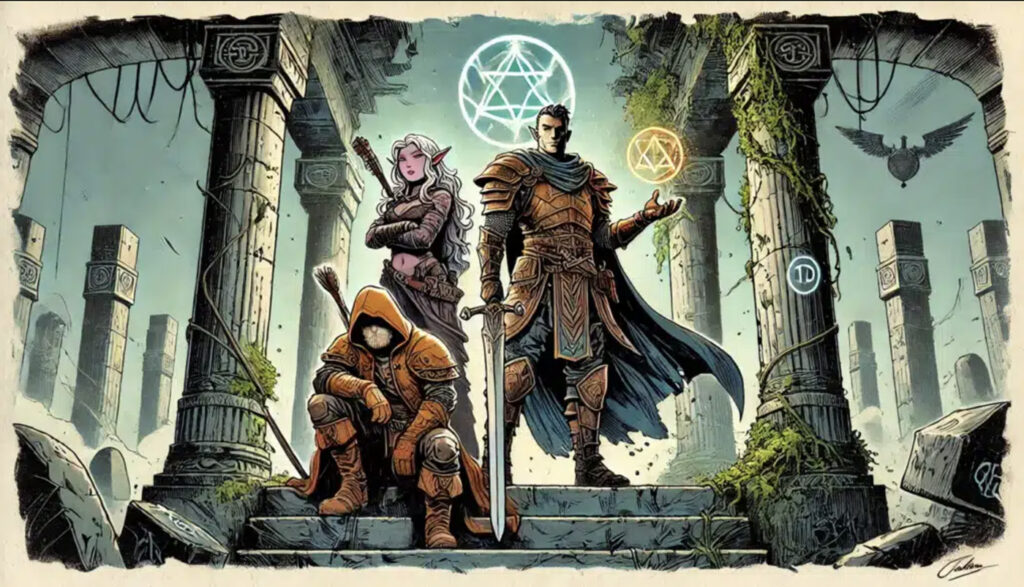
Few decisions shape a Dungeons & Dragons campaign as much as the party composition sitting around the table on session one. A well-balanced party can handle nearly anything a dungeon master throws at it, while an unbalanced group often finds itself scrambling through encounters that a smarter combination of classes and roles would have handled with relative ease. Whether you are assembling a brand-new group or trying to fix recurring problems in an existing one, understanding what “balance” actually means, and how to achieve it without forcing players into roles they don’t want to play, makes for a smoother and more satisfying campaign.
What Balance Actually Means in a D&D Party
Balance does not mean every party needs exactly one fighter, one wizard, one cleric, and one rogue in a rigid formation. Modern D&D, particularly in its more recent editions, has blurred traditional class boundaries considerably, with many classes capable of filling multiple roles depending on subclass choice and build. True balance is better understood as coverage across four core functional roles: tanking and frontline durability, damage output, support and utility, and skill-based problem solving outside combat.
A party missing coverage in one of these areas is not necessarily doomed, but it will need to work harder, rely more heavily on tactics and resource management, or lean on the dungeon master adjusting encounter difficulty to compensate for the gap. Recognizing these functional roles, rather than fixating on specific class names, gives players far more flexibility in building a party that both covers its bases and reflects the character concepts players actually want to play.
The Four Core Roles Explained
Frontline Durability (Tanking)
Someone in the party needs to be able to absorb hits, hold enemy attention, and survive prolonged melee engagement without collapsing after a few unlucky rolls. This role is traditionally filled by fighters, paladins, and barbarians, though certain cleric and druid builds can fill a similar function through high armor class, healing self-sufficiency, or damage mitigation abilities.
A party entirely lacking frontline durability tends to suffer badly in melee-heavy encounters, since squishier characters end up absorbing hits meant for a tankier build, often leading to dangerous, unplanned retreats or an over-reliance on ranged kiting tactics that not every dungeon master’s encounter design accommodates well.
Damage Output
Every party needs reliable ways to end fights before resources run out, whether through sustained weapon damage, spell damage, or burst nova damage concentrated into a few devastating turns. Rogues, rangers, most fighter subclasses, and blaster-oriented wizard or sorcerer builds typically fill this role, though damage output exists on a spectrum from steady, reliable output to high-risk, high-reward burst potential.
A party overloaded with pure damage dealers but lacking support can find itself winning fights quickly but struggling badly when a fight goes longer than expected or when resource attrition across multiple encounters in a single adventuring day starts to matter.
Support and Utility
This role covers healing, buffing, crowd control, and battlefield control effects that make everyone else in the party more effective. Clerics, bards, and druids are classic examples, though many classes can contribute meaningful support through specific spell or feature choices even if support is not their primary build focus.
Parties without dedicated support often survive individual encounters fine but struggle with attrition across a full adventuring day, since healing resources become scarce and buffs that would have made difficult fights significantly easier are simply unavailable.
Skill-Based Problem Solving
Combat is only part of a typical D&D session, and a party without strong skill coverage, including perception, investigation, persuasion, deception, stealth, and arcana or religion knowledge checks, can struggle badly with the non-combat half of the game. Rogues, bards, and rangers often carry significant skill coverage, though any class can contribute meaningfully here depending on background choice and stat allocation.
Building Balance Without Forcing Player Choice
The single biggest mistake groups make when trying to build a balanced party is treating role assignment as more important than what players actually want to play. Forcing a player who wants to play a frontline barbarian into a support cleric role because “the party needs healing” often produces a resentful, disengaged player, which does far more damage to a campaign’s long-term success than a genuine mechanical gap in party coverage ever would.
A better approach starts with an open conversation before character creation, where players share their concept ideas and the group collectively identifies gaps, allowing individual players to voluntarily adjust their build within their preferred class or concept to help cover a missing role, rather than abandoning their concept entirely. A player who wants to play a barbarian, for example, might lean toward a subclass with some support utility, or simply accept that the group will need to rely more on tactics and consumables to cover a gap, rather than being pressured into an entirely different class.
Handling Gaps When They Happen Anyway
Even with careful planning, some parties end up with genuine gaps, whether due to player preference, character death and replacement, or a player leaving the group mid-campaign. Several practical solutions exist for groups facing this situation.
- Multiclassing allows an existing character to pick up levels in a class that covers a missing role, though this requires careful planning to avoid diluting the character’s core concept too much.
- Hireling NPCs controlled by the dungeon master or shared among players can fill a specific missing role, such as a healer, without requiring any player to sacrifice their preferred character concept.
- Magic items can partially compensate for gaps, such as healing potions covering a lack of dedicated healer, or items granting skill bonuses covering weak skill coverage.
- Dungeon master encounter adjustment remains one of the simplest solutions, since a dungeon master aware of a party’s specific gaps can calibrate encounter difficulty and design accordingly rather than expecting the party to overcome challenges built around an assumption of full role coverage.
Party Size Considerations
Party balance also depends heavily on group size. Smaller parties of three or fewer players generally need tighter role coverage, since there is less redundancy to fall back on if one character is incapacitated or absent for a session. Larger parties of six or more players have more natural redundancy and can afford more specialized or unconventional builds, since gaps in one character’s coverage are more likely to be offset by another party member’s strengths.
Dungeon masters running smaller parties should also consider scaling encounter difficulty down somewhat to account for reduced action economy and role redundancy, rather than running encounters designed around the assumption of a standard four to five player party.
Balancing Playstyle Alongside Mechanical Role
Mechanical role coverage is only half of what makes a party feel balanced at the table. Playstyle compatibility matters just as much, since a party full of cautious, methodical planners paired with one player who prefers impulsive, high-risk decisions can create friction that has nothing to do with class choice or action economy. Groups that discuss preferred playstyle alongside mechanical concept during session zero tend to avoid a common source of table tension: one player feeling constantly held back by an overly cautious group, or conversely, a cautious player feeling constantly put at risk by a reckless teammate.
This is also where dungeon masters can help proactively, by designing encounters and narrative hooks that give each playstyle a moment to shine rather than consistently rewarding only one approach. A dungeon master who occasionally rewards bold, high-risk plays alongside careful, methodical ones helps keep a mixed-playstyle party feeling balanced in a way that goes beyond simple class and role coverage.
When the Table Wants a Break From the Campaign
Even the best-balanced party needs an occasional night off from the campaign, and plenty of groups use that downtime for other games that scratch a similar competitive itch, from card games to platforms like Faircrown login, before diving back into the next session.
Common Party Composition Mistakes to Avoid
Several recurring mistakes show up repeatedly in poorly balanced parties, and recognizing them early makes for a smoother campaign overall.
Overloading on a single role, such as three separate damage-focused melee characters with minimal ranged options, leaves the party vulnerable to encounters featuring flying enemies, ranged attackers, or difficult terrain that limits melee engagement. Similarly, a party entirely lacking any character with strong social skills can find themselves struggling badly through roleplay-heavy sessions that a dungeon master has built significant content around.
Frequently Asked Questions
Does every D&D party need exactly one tank, one healer, one damage dealer, and one skill character?
No. Balance is better understood as coverage across functional roles rather than rigid class assignments, and many classes can flexibly fill multiple roles depending on subclass and build choices.
What happens if a party has no dedicated healer?
The party can compensate through healing potions, a dungeon master adjusting encounter difficulty, or characters taking feats and spells that provide alternative healing or damage mitigation options.
Should players be assigned roles before character creation to ensure balance?
It is better to have an open conversation about concepts first and let players voluntarily adjust within their preferred class to cover gaps, rather than forcing role assignments that reduce player engagement.
Does party size affect how important balance is?
Yes. Smaller parties need tighter role coverage due to less redundancy, while larger parties can absorb more specialized or unconventional character builds.
Can multiclassing fix a party’s role gaps mid-campaign?
Yes, multiclassing is a common solution, though it requires careful planning to ensure the character’s core concept and mechanical effectiveness are not overly diluted.