
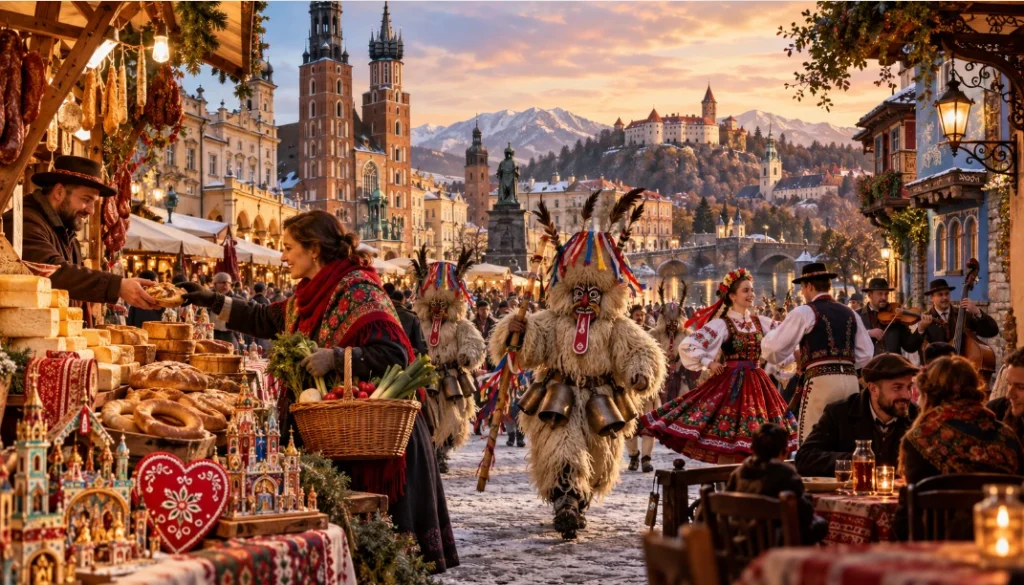
At Kraków’s morning market, shoppers carry bags of bread and vegetables past stalls selling smoked cheese. In a small Slovenian town, masked figures ring heavy bells to mark the end of winter. The contrast is striking.
Some travelers become curious about the region through family roots, friendships, or reading about dating slavic women. Shared linguistic roots do not erase local differences.
Where to Go for a Closer Look at Slavic Traditions
Kraków, Poland: Christmas Crafts and Everyday Food
In Kraków, ordinary routines unfold beside historic sights. Start at a neighborhood bakery for an obwarzanek, the ring-shaped bread sold throughout the city, then walk through Stary Kleparz market to see what residents actually buy.
The most distinctive seasonal experience arrives in December. Local craftspeople create elaborate szopki, miniature nativity scenes inspired by Kraków’s towers and facades. UNESCO recognizes this craft as intangible cultural heritage.
Kazimierz deserves time as well. Its synagogues and Jewish cultural institutions reveal an important part of Kraków’s history that cannot be explained through Slavic identity alone. Allow two days for a neighborhood walk beyond the Main Square.
Strážnice, Czechia: Folk Music Beyond Prague
Prague has remarkable architecture, but the town of Strážnice in South Moravia is a stronger choice for visitors interested in folk performance. Its open-air museum presents traditional rural buildings and crafts.
During the annual folklore festival, musicians and dancers gather in embroidered clothing associated with different communities. Rather than assuming every costume is “Czech,” look at the descriptions: patterns, colors, and headwear can identify a particular area.
Wine cellars and small villages offer a slower experience, though public transport can be limited after dark. Stay overnight instead of rushing back to a major city.
Ptuj, Slovenia: A Winter Ritual with Cowbells
In the weeks before Lent, Ptuj hosts Kurentovanje, a carnival built around the kurent, a figure dressed in sheepskin with bells and an elaborate mask. The ringing and movement are traditionally associated with driving away winter. UNESCO lists the door-to-door rounds of Kurents as intangible cultural heritage.
Local groups prepare for this community tradition. Watch public processions without stepping into performers’ paths or touching costumes.
Outside carnival season, visit Ptuj’s castle collections and compact old town.
Zagreb, Croatia: Market Habits and Handmade Hearts
The Croatian capital rewards travelers who like discovering culture in small details. Visit Dolac market in the morning, when stalls are active and locals are shopping. Nearby cafés are ideal for watching daily life.
Look for licitar, brightly decorated gingerbread, often made in the shape of a red heart. This northern Croatian craft is recognized by UNESCO, and the decorations are commonly given as keepsakes rather than eaten as ordinary snacks.
For a traditional meal, try štrukli, pastry filled with fresh cheese, and compare restaurant versions with those sold in simpler local eateries.
Plovdiv, Bulgaria: Revival-Era Houses and Living Arts
Plovdiv’s old town reveals several periods of Bulgarian history. Colorful nineteenth-century houses stand near traces of Roman and earlier settlements, while the Kapana district has workshops, cafés, and contemporary art spaces.
Visit a house museum to understand the carved ceilings and painted facades.
Food gives another introduction. Order banitsa, a pastry commonly made with cheese, at a bakery rather than assuming every restaurant menu represents everyday Bulgarian cooking. If you encounter a public horo dance, watch how participants join hands and move together, but follow the lead of local dancers before stepping in.
Belgrade, Serbia: The Social Life of the Kafana
Belgrade’s kafana tradition is best understood over an unhurried evening. These taverns have long served as places for conversation, meals, and music. Skadarlija, the city’s historic bohemian street, is an easy starting point, with older restaurants and live performances.
The experience can feel staged during busy hours. Compare it with a neighborhood kafana away from the center, and notice differences in menus, prices, and the crowd.
Serbian food often features grilled meat, but vegetable dishes, roasted peppers, and salads are also part of the table. Ask about portion sizes before ordering several shared plates.
Choosing the Right Destination and Season
For a short city break, Kraków or Zagreb offers markets, museums, and traditional food without requiring a car. Strážnice suits travelers who can plan around a festival and enjoy rural areas. Ptuj is particularly memorable during carnival season; Plovdiv works well for architecture and craft interests, while Belgrade puts food and music at the center of the trip.
December is associated with Kraków’s nativity-scene tradition, while Ptuj’s carnival falls before Lent. Summer is a common period for folk festivals, but exact programs change, so check local calendars before paying for accommodation.
How to Experience Local Culture Without Treating It as a Show
- Pick one tradition before booking. Find out whether it happens on a specific day, throughout a season, or only in certain villages.
- Leave space for ordinary places. A market, bakery, or local museum often explains more about daily habits than a packed sightseeing route.
- Learn the basic greetings. Even a few words in Polish, Czech, Slovenian, Croatian, Bulgarian, or Serbian show attention. Do not assume one Slavic language works everywhere.
- Ask before photographing people. This is especially considerate around religious gatherings, craftspeople at work, and small community events.
Polish and Czech use the Latin alphabet; Bulgarian uses Cyrillic, while Serbian is written in both Cyrillic and Latin. Read local signs carefully, follow the etiquette of religious spaces, and give yourself time to notice what makes each place distinct.
A useful final choice when planning your trip is to spend an extra night in one town rather than adding another capital to the itinerary. That leaves time for a return visit to a market, an evening performance, or the kind of conversation that rarely fits between train departures.