
Every table has that moment. The rogue needs a 15, the whole party leans in, and the die clatters across the map before settling on a natural 1. Groans, laughter, a story everyone will retell for months. That swing is randomness doing its job, and it is the same force behind loot drops, procedurally built worlds, and the reels of a slot machine.
The tools look different, but the idea underneath barely changes. A spin on a slot uses a random number generator that decides the result the instant you press the button, just as a d20 decides the instant it stops rolling. If you want to watch that randomness in a competitive setting without spending anything, a free slot tournament uses virtual credits and a public leaderboard, and you can see how they work here. Before that, though, let’s look at the dice.
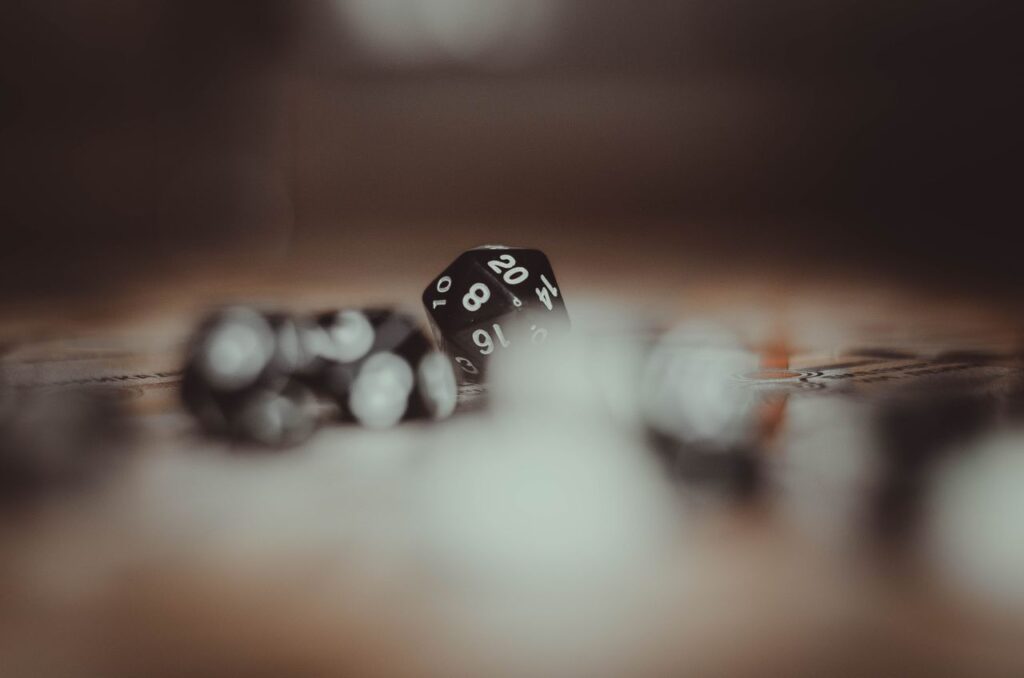
The d20: Flat Odds, Big Drama
A fair twenty-sided die gives every face the same 5% chance. That flat curve is why a d20 feels so swingy. A level 1 fighter and a seasoned hero have the same odds of rolling a natural 20, and the same odds of fumbling.
Compare that with rolling 3d6, the old way to generate ability scores. Three dice add up to a bell curve: a 10 or 11 shows up 12.5% of the time each, while an 18 lands only once in 216 rolls. The number of dice you roll matters more to the feel of a game than the number of sides on them. A system built on 3d6 rewards skill and planning, while a single d20 keeps everyone humble.
Advantage And The Hidden Math Of Rerolls
Fifth edition’s advantage rule is simple on paper. Roll two d20s, keep the higher one. In practice, it shifts the odds far more than most players expect.
- Your average roll jumps from 10.5 to about 13.8.
- The chance of at least one natural 20 nearly doubles, from 5% to 9.75%.
- If you need an 11 or higher, success climbs from 50% to 75%.
- Disadvantage flips it all: a natural 20 drops to a 1 in 400 shot.
Disadvantage is my favorite thing to explain to new players. When the DM hands out disadvantage on a roll that needs an 11, your odds fall from 50% to 25%, about the same as a flat minus 5. It sounds like a small rule. It is not.
When Computers Roll The Dice
Video games cannot toss a physical die, so they use pseudo-random number generators. These are algorithms that start from a seed value and produce a long sequence of numbers that look random. Feed in the same seed, and you get the same sequence every time.
That is why sandbox games let you share a world seed with friends and explore identical maps. It is also why speedrunners in older console games learned to manipulate luck by timing inputs to specific frames. The randomness was real enough for casual play but predictable to anyone who mapped it out.
Designers also bend randomness on purpose. One classic tactics series rolled two numbers and averaged them for attacks, so a displayed 80% hit actually landed about 92% of the time. Many loot systems add pity timers that guarantee a rare drop after a long dry spell. Players hate streaks of bad luck more than math says they should, and good design accounts for that.
Slot Machines: The Purest RNG Around
Slots strip randomness down to its core. In regulated markets, each spin is decided by a certified random number generator, and independent labs test those systems for fairness. No pity timer and no DM is fudging the roll behind a screen.
Two ideas trip people up with slots. First, every spin is independent, so a machine is never due for a win after a cold streak. Second, the return to player figure, such as 96%, is an average across millions of spins. Over one evening, your results can land far above or below it. That is the same lesson a d20 teaches: short runs are wild, long runs settle down.
This table shows how the main sources of randomness compare.
| Source | How It Works | What It Feels Like |
| Single d20 | Flat 5% per face | Swingy and dramatic |
| 3d6 | Bell curve around 10 and 11 | Steady and predictable |
| Advantage | Roll 2d20, keep the higher | Reliable without being certain |
| Video game RNG | Seeded algorithm, often adjusted | Fair, sometimes quietly softened |
| Slot RNG | Certified, every spin independent | Pure chance with no safety net |
If you try slots for fun, keep it that way. Play only if you have reached the legal gambling age where you live, set a time and money limit before you start, and treat free play modes as the safest place to learn how a game behaves.
Why We Love Not Knowing
Randomness keeps a game from becoming a spreadsheet. If every attack hit, combat would be a checklist. The tension of an uncertain roll is what makes a lucky crit feel earned and a failed save feel dramatic.
There is also a social side. At a table, a wild roll becomes a shared memory. Online, a rare drop or a big leaderboard jump gets screenshotted and posted. We remember the outliers, which is exactly why we keep rolling.
Rolling Forward
From the clatter of a d20 to code running inside a slot, randomness follows the same core idea: every roll has its odds, whether flat, curved, or quietly softened, and the long averages only show up over time. Knowing the math will not save your rogue from a natural 1, but it will help you read your odds honestly. Next session, try counting how often advantage actually changes the outcome. You might be surprised.