
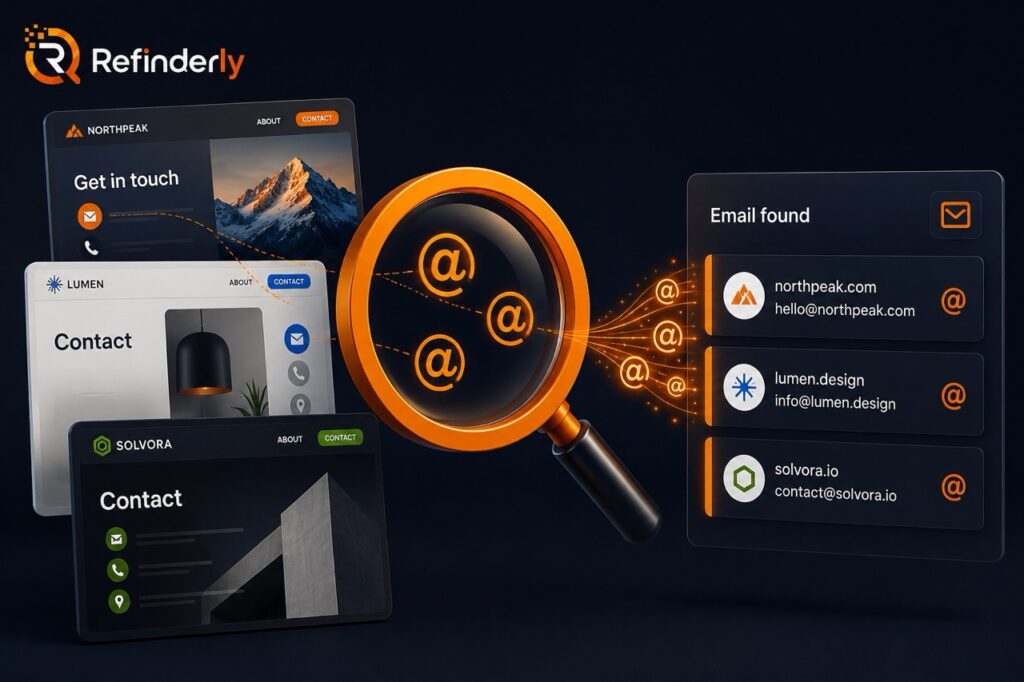
Reliable contact information supports many everyday business activities, from sales and supplier outreach to partnerships, PR and corporate communications. Finding those details manually may be manageable for a handful of companies, but the process becomes slow and inconsistent when a team needs to research dozens or hundreds of websites. Contact pages differ between sites, while addresses saved in older spreadsheets may no longer accept messages.
Refinderly brings email discovery and verification into one workspace. Businesses can search live websites for contact addresses the companies have published, review the original pages where those details were found and check whether existing emails appear able to receive mail. Instead of charging for every submitted row, the platform uses a shared credit balance and charges for delivered results. This gives teams a practical way to build and prepare business contact lists while reducing repetitive research and avoiding charges for searches or checks that return no answer.
Why Growing Businesses Choose Refinderly for Contact Research
Contact research becomes harder to manage as the number of target companies increases. Opening a few websites manually is straightforward, but checking dozens or hundreds of domains means repeatedly searching homepages, footers, About sections and contact pages. Those pages do not always follow familiar naming conventions. An international website may use a local-language path instead of /contact, while some businesses display their details only after JavaScript has loaded. Basic scraping methods can therefore miss information that is visible to an ordinary visitor.
Existing contact lists create a different problem. An email saved several months ago may still look legitimate even though the mailbox has been removed or the domain’s mail setup has changed. Duplicate entries can also lead to the same contact being processed more than once. If these issues are discovered only after a campaign begins, the business wastes sends on addresses that cannot accept mail and increases the number of avoidable bounces.
Refinderly is designed for teams that need to process complete lists rather than research one company at a time. Users can paste their data or import .csv and .xlsx files, while duplicate entries are removed before processing and billing. The platform then supports two connected stages of contact preparation: finding email addresses that companies publish on their websites and checking whether addresses from existing lists appear able to receive mail. Keeping these tasks in one workspace gives businesses a clearer route from a domain list to contact data that is ready for review before sending.
Refinderly Turns Domain Lists Into Business Contacts
A list of relevant companies has limited value until it includes a practical way to reach them. Researching every domain separately means moving between websites, locating the right pages and transferring contact details into a spreadsheet by hand. Refinderly Email Finder turns that starting list into organized contact data by searching the websites themselves, without relying on a purchased database or generating email addresses that a company has never published.
Because the search runs against live websites, the results reflect the information available when the business starts the job rather than a previously compiled data export. Refinderly can return up to three published email addresses for each domain and ranks them by likely usefulness. For example, a role-based address on the company’s own domain is prioritized over an unrelated free-mail account. Whether one or three contacts are found, the domain uses a single credit.
Each result also includes the page where the email was discovered. This gives employees a direct source they can review before deciding which address fits the purpose of their message. Refinderly can also collect company profiles linked from the website on LinkedIn, Facebook, X, Instagram and Telegram, providing alternative contact channels and additional context.
The resulting table is more than a list of extracted addresses. Every email found receives a deliverability verdict within the same credit, so the business can see both where the contact was published and whether the mailbox appears able to accept mail. Results can then be exported to Excel or sent to Google Sheets for use in the team’s existing workflow.
How Refinderly Reduces Manual Work Without Sacrificing Control
Automation is most useful when it speeds up contact research without hiding how the results were obtained. Refinderly keeps the submitted domain, discovered email address and source page together in the results table. Instead of accepting an isolated contact with no visible origin, an employee can open the relevant page and confirm that the business published the address itself.
This context is particularly valuable when a website lists several mailboxes for different purposes. Reviewing the source page can show whether an address is intended for general enquiries, commercial requests or another type of communication. The employee still makes the final decision, but no longer has to repeat the full search across every website. This helps businesses work through larger domain lists while retaining control over which contacts enter their campaigns.
Refinderly also accounts for differences that make international contact research difficult to automate consistently. It recognizes contact pages in more than 15 languages, so the search is not limited to familiar English paths. When information appears only after JavaScript runs, the page can be loaded in a browser before its content is examined. The tool can also interpret certain obfuscated formats, including addresses written with “[at]” in place of the usual symbol.
These capabilities expand the search beyond what a basic page scraper may detect, but they do not replace evidence with assumptions. If an accessible website does not publish an email address, Refinderly leaves the result empty instead of constructing a likely-looking contact. The business receives fewer unsupported entries and retains a clear source for every address it considers using.
A Larger Email List Is Not Always a Better Business Asset
The number of contacts in a database says little about how useful that database will be. A large email list can still produce weak results if it contains outdated mailboxes, duplicate records or domains without functioning mail servers. In practice, a smaller list of relevant and reviewed contacts is often more valuable than thousands of entries whose current status is unknown.
These problems usually develop gradually. CRM records remain untouched after a contact changes roles, while spreadsheets assembled by different employees may contain the same address in several versions. Contacts retained from previous campaigns can stay in circulation long after they were last checked. Third-party exports introduce another layer of uncertainty because the business may not know when or how the addresses were collected. Even an email copied manually from a website several months earlier may no longer accept messages.
Verification allows a business to assess these existing records before using them in a new campaign. It can identify addresses that appear able to receive mail, those expected to bounce and cases where the receiving server does not provide a conclusive answer. This gives the team a basis for separating contacts instead of treating every row as equally reliable.
Fresh results from Refinderly’s Email Finder do not need to be submitted for a second check. Every address discovered during the search already receives a deliverability verdict within the credit charged for that domain. The separate verification tool is intended for lists collected elsewhere or for contacts old enough to require another check. Keeping that distinction clear prevents businesses from spending credits on a verdict they already have.
Refinderly Helps Businesses Check Contacts Before Sending

Before launching a business email campaign, teams can use Email Verifier to assess a contact list they already have. The tool checks whether each address appears able to receive mail and returns the result before the company spends a send on it. This makes it possible to remove clear failures, separate uncertain contacts and prepare the database according to the available evidence.
Refinderly reports four distinct verdicts. A Deliverable address has been accepted by the receiving mail system and can be considered for communication. An Undeliverable result indicates that the message would bounce, so the address should be excluded from sending. Risky means the domain uses a catch-all setup that accepts mail for any address, making it impossible to confirm that the individual mailbox exists. These contacts can be placed in a separate segment and reviewed according to their relevance. Unknown is returned when the server does not provide enough information for a conclusion. The address can be kept aside or checked again later, and no credit is charged for this outcome.
Every verdict is accompanied by a Reason. This additional detail shows whether, for example, the mailbox does not exist, the domain has no mail server or the server did not answer. As a result, businesses can distinguish between different problems instead of placing every questionable contact in the same category.
Verification provides a clearer basis for deciding how to handle an address, but it does not predict campaign performance. Deliverable means that the mailbox accepts mail; it does not guarantee that the recipient will open the message, respond or become a customer.
Why Refinderly’s Credit Model Fits Variable Business Needs
Contact research does not always produce a usable result. A website may publish no email address, refuse automated access or be unavailable when the search runs. Refinderly accounts for this by charging credits for delivered answers rather than every row submitted for processing. Businesses can therefore work with real domain and email lists without paying for entries that produce no result.
In Email Finder, one credit is charged when a domain returns at least one published email. The price does not increase if two or three addresses are found on the same website. If no contact is available, the domain cannot be reached or the website blocks the search, no credit is used. Duplicate domains are removed before processing, preventing the same entry from being searched and billed more than once.
Email Verifier follows a similar principle. A completed Deliverable, Undeliverable or Risky verdict costs one credit because the check produced an answer. Unknown is free, as the receiving server did not provide enough information to determine the status of the address. Duplicate emails are also removed before the verification begins.
New accounts receive free starting credits after email confirmation, allowing a company to test the tools with its own domains and addresses before selecting a paid plan. Paid plans are purchased for a chosen monthly, quarterly or yearly term and do not renew automatically.
This structure accommodates different workloads without requiring every customer to operate at the same scale. A small business can begin with a focused contact list, while an agency or sales department can process larger batches. Team members use one shared credit balance across Refinderly’s metered products, making it easier to allocate available credits according to current research and verification needs.
Make Refinderly Part of a More Reliable Business Workflow
A useful business contact list begins with relevant companies rather than a collection of unrelated email addresses. Once a team has identified potential clients, suppliers or partners, it can upload the corresponding domains to Refinderly and search for contact details published on their current websites. Each discovered address is presented with its source page, allowing the team to review the context before deciding whether it belongs in the campaign.
Older CRM records, contacts collected manually and lists obtained from external sources can be handled separately. Verification results help distinguish addresses that accept mail from those expected to bounce, while Risky and Unknown contacts can be placed in separate groups for further consideration. The prepared data can then be exported to Excel or Google Sheets, where employees can organize it around the needs of a specific campaign.
Refinderly does not decide which companies a business should approach or write personalized messages on its behalf. Those choices still depend on the team’s audience, offer and communication strategy. Its role is to reduce the technical workload involved in locating published contact details, checking existing email addresses and preparing the results for further use.
Businesses can create a free account, confirm their email and use the starting credits to test both contact search and email verification with their own data. This provides a practical way to see how Refinderly fits an existing workflow before moving to a paid plan.