
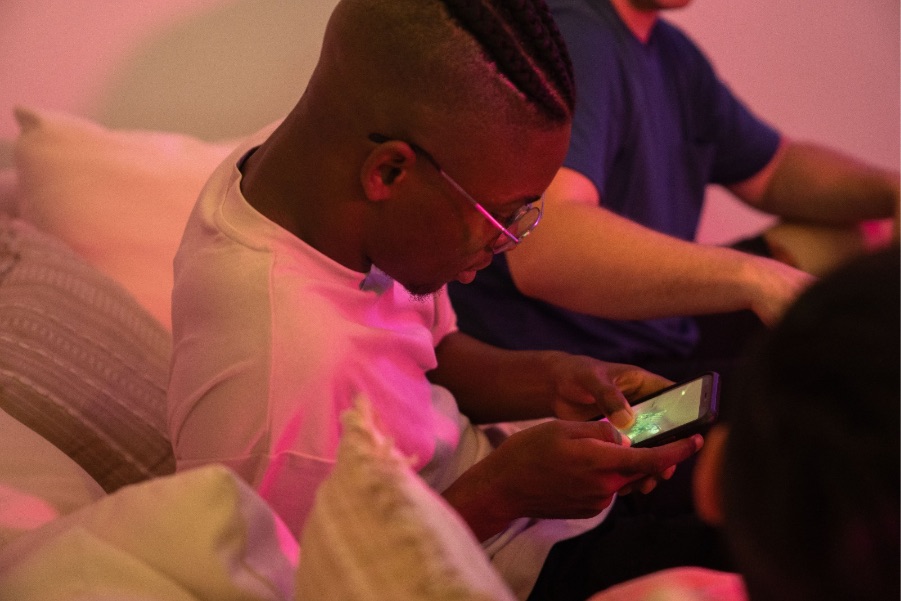
At the turn of the millennium, entertainment consisted of evenings in front of the telly, maybe a trip down to the local Blockbuster, or hijacking the family TV for a shot on a games console. The arrival of the smartphone didn’t just introduce new forms of entertainment, it swallowed all of the existing ones along the way. In less than two decades, the UK’s entertainment habits have evolved from tethered and scheduled to free-roaming and on-demand. Here’s how the mobile entertainment revolution changed screen time as we know it.
Britain Before the Smartphone
Before the launch of the first smartphone, the iPhone in 2007, entertainment was tethered to specific devices, certain rooms, and tight scheduling.
The internet was restricted to a large, cumbersome desktop computer in the corner or in a separate room. Though some still used that familiar screechy dial-up for their internet connections, ADSL broadband was becoming more common. That meant sharing the phone line for internet and calls was possible, but speeds were still pretty abysmal.
TV and radio were fixed in place, with shows subject to strict scheduling. You either sat down to watch or tune in at the right time or you missed out. Many evenings revolved around TV scheduling, while mornings were filled with sounds from the kitchen or car radio.
Newspapers were a familiar sight on trains, buses, and in coffee shops, filling the daily commute with the telltale rustling of tabloids, broadsheets, and free papers like the Metro.
Gaming was also situational and controlled, with consoles needing a hookup to the family TV, often triggering arguments over screen time. Portable gaming was restricted to devices like the Game Boy or Nintendo DS, but battery life was limited.
Further highlighting just how different things were is the data on smartphones. A year after the iPhone was launched, a retrospective of Ofcom’s 2008 Communications Market Report showed that only 17% of UK adults owned a smartphone. Compare that to 95% in 2025, as noted by Finder.
The Smartphone Becomes an Entertainment Hub
Once smartphone technology advanced, they evolved from devices designed simply to make calls into a mobile entertainment hub. They effectively gathered together all the separate, fragmented forms of entertainment into one portable, pocket-sized device.
Thanks to streaming capabilities and online video platforms, viewing is no longer restricted to evenings gathered round the telly or a trudge to the local Blockbuster. Netflix, Amazon Prime, and YouTube have turned our smartphones into mobile cinemas, so you can watch your favourite films and shows anywhere. Ofcom’s Media Nations 2026 Report shows that 70% of UK households had at least one subscription video-on-demand (SVOD) service in Q1 2026, with 84% of 16-24 year olds watching video on demand.
Podcasts and music platforms became the upgraded versions of radio shows and shop-bought CDs. Platforms like Spotify put an entire music catalogue in our pockets, while radio station apps and podcast publishers means we can tune in to what we want, whenever we want.
Newspapers are pretty much redundant now thanks to today’s instant digestible news that’s delivered as live push notifications via website or app.
And keeping up with the gossip is about more than catching up with friends. Social media platforms like TikTok and Instagram have become video-rich entertainment sites that revolve around endless scrolling. According to DataReportal’s Digital 2025 report, there were 54.8 million active social media user identities in the UK in January 2025, some 79% of the population. We Are Social’s Digital 2025 report indicates that we use social media for an average of 1 hour and 37 minutes each day.
From Scheduled Entertainment to On-Demand Entertainment
Before smartphones became so widespread, entertainment was heavily scheduled. You had to be sitting in front of the telly at the right time to watch your favourite show or a film, or hope to catch the weekend omnibus or a DVD release.
The smartphone broke this scheduled rigidity with anytime accessibility. Instead of having to wait for the right time, on-demand entertainment meant we could watch our shows at a time that suited us. Forget waiting for the 6pm news to find out what was going on in the world. Instant breaking news notifications meant we could stay current effortlessly. No more hoping to hear our favourite song on the radio; mobile-friendly music platforms meant we could listen to personalised playlists on repeat.
This has resulted in a massive shift in our viewing habits. While tuning in to traditional broadcast TV continues to fall, Ofcom’s Media Nations 2026 Report shows 80% of adults use video-on-demand services at least once a month, up from 64% in 2019. Smartphones mean we’re no longer tethered to devices or schedules: we’re free to watch, listen to, and play whatever we want, whenever we want.
The Second-Screen Habit
The smartphone has become so embedded in our everyday lives that it’s no longer just a primary screen. It’s become a constant companion that we use even when viewing other screens. This so-called second-screening takes the form of social media scrolling or consuming other forms of entertainment while we’re watching TV, at a live event, or commuting.
Instant gratification and multi-tasking have combined to the point where it’s natural for us to look up an actor’s other appearances during a film or check out live commentary while watching a reality TV show.
Second-screening is pretty common. A March 2026 YouGov poll revealed that almost two-thirds (64%) of Brits look at a second screen at least some of the time during TV shows and 56% while watching films.
Smartphones have become pocket-sized filler entertainment for any moment of downtime during our day, whether that’s on the commute to work or during slow plot points or ad breaks of films and series.
Gaming Moves Into Our Pockets
Gaming used to be pretty niche; it meant spending hundreds on a console or top-of-the-range PC and hijacking the family TV. Smartphones have changed all that, with mobile gaming now accessible to anyone anywhere with a minute or two to spare.
App stores are now home to a huge range of free or low-cost titles, everything from casual puzzlers to massive multiplayer games. Wider accessibility and more choice means the gaming demographic has shifted dramatically. Ofcom’s Adults’ Media Use and Attitudes 2026 Report reveals that almost two-thirds (65%) of adults play games, with the majority of those (47%) playing on mobile phones, topping games consoles (32%) by a healthy margin.
Every genre seems to have made the move to mobile. The rise of mobile casino entertainment means users no longer need a home-based PC or land-based venue to spin the reels, beat the dealer at blackjack, or try their lucky numbers at the roulette wheel. Smartphones have brought out the gamer in just about all of us.
How Faster Mobile Networks Changed BehaviourHow Faster Mobile Networks Changed Behaviour
Today’s super-fast, always-present mobile entertainment didn’t come about in a vacuum. The development of the necessary mobile network infrastructure from 3G to 4G and 5G has been a critical part of the process.
The rollout of 4G across the UK in 2012-13 took us from simple text and image viewing to being able to watch YouTube videos or download podcasts on the go. Alongside public wifi and faster home broadband, 5G took us another step forward, eliminating the annoying buffering ring and enabling HD streaming from anywhere.
As a result, our data consumption has gone through the roof. In 2025, we used 18% more mobile data than in the previous year at an astonishing 1.2 billion GB each month, says Ofcom’s Connected Nations 2025 report. From the six months to January 2026, Ofcom’s Connected Nations Spring 2026 update shows that up to 85% of the UK now has full 5G coverage outdoors and up to 94% has overall access to 5G. This is a few percentage points up on the previous year and will no doubt lead to more mobile data consumption.
What’s Next for Mobile Entertainment?
Smartphones have already taken over the job of our old TVs, radios, and games consoles, and the lines between our various forms of mobile entertainment will continue to blur. Major streaming platforms already feature games in amongst their films and series, while multiplayer games are hosting virtual social events like concerts and film premieres.
The common ground seems to be the social aspect. Deloitte’s 2026 Digital Media Trends report found that 52% of fans primarily use social media platforms to learn about their chosen form of entertainment.
Add in AI and new interactive content formats and we see the future of mobile entertainment as a continuous cultural conversation, all in the palm of our hand.