
Every group has the player who wants to know the odds before rolling. They ask whether the Sharpshooter feat is worth the -5, they work out average damage on a napkin, and they quietly track how often the DM’s goblins actually hit. That player is doing what casino designers have done for a couple of centuries: treating chance as something you can shape, price and balance.
Board game and RPG designers borrow from the same toolbox, whether they say so or not. Push-your-luck games, deck-builders and even the humble d20 all lean on ideas that roulette wheels and blackjack tables refined long before Catan hit a shelf. Looking at those classic games with a designer’s eye says a lot about why some tabletop mechanics feel fair and others feel rigged.
The house edge is just a balance budget
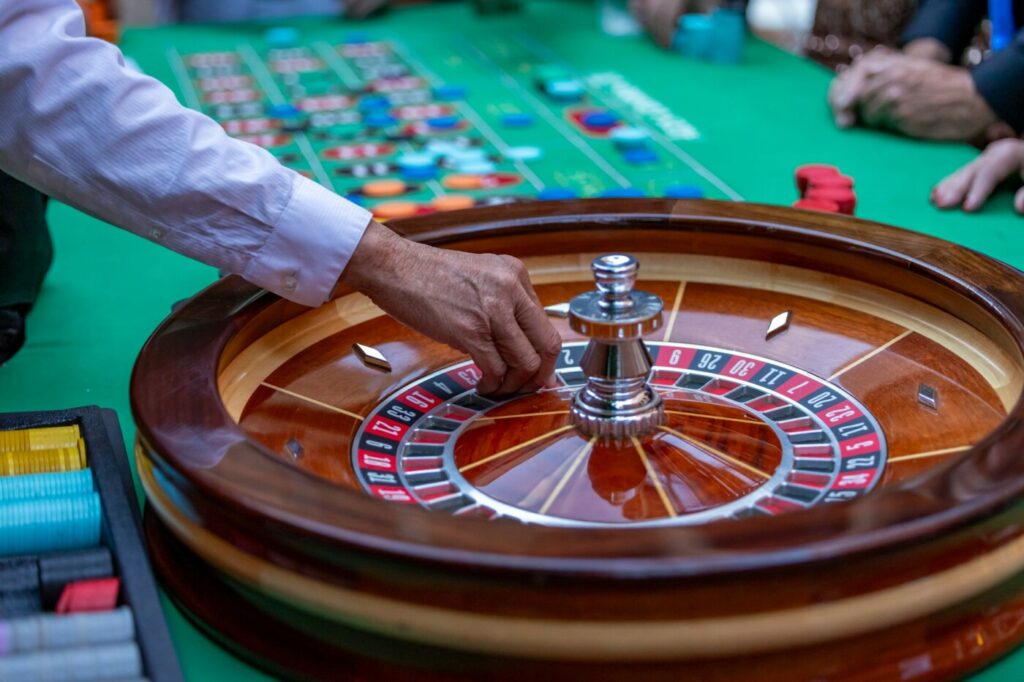
Take roulette. A European wheel has 37 pockets, numbers 1 to 36 plus a single zero, yet a straight bet pays 35 to 1 instead of 36 to 1. That one missing payout is the whole business model. As the breakdown of the single-zero wheel’s math shows, it works out to a margin of roughly 2.7% on every spin, small enough that players barely feel it on any given night.
Tabletop designers make the same trade constantly, only the currency is fun rather than money. When a card in a deck-builder costs four coins instead of three, the designer is setting a small, steady tax on a strong effect. When a 5e monster gets a +1 to hit, the encounter tilts a few percentage points toward the DM. Players rarely notice a single tweak. They notice the sum of them over a three-hour session, and they notice fast when the budget is off.
The lesson casinos learned early is that the edge works best when it is consistent and modest. A roulette wheel that took 20% would empty the table. A dungeon where every trap is a coin flip for death empties the table too, just with more complaining.
Push your luck, and the art of the near miss
Blackjack is the cleanest push-your-luck game ever printed. Each card is a decision: stop with what you have or risk going bust for something better. Games like Quacks of Quedlinburg, Can’t Stop and Incan Gold run on exactly that loop, and they work for the same reason. The choice is simple, the tension rises with every draw, and the player feels responsible for the outcome even when the deck decided it.
Blackjack also proved that a chance game can reward skill. In 1962 the mathematician Edward Thorp published Beat the Dealer, which, according to this account of his work on card counting, showed the house advantage could be overcome by tracking which cards had already left the shoe. For game designers that is a useful idea. Players love systems where paying attention pays off. A deck-builder that lets you count what is left in your draw pile, or an RPG combat where noting the enemy’s resistances changes your tactics, gives the analytical player at the table something real to do.
The flip side is the near miss. Casino designers know that almost winning keeps people playing, and good tabletop design uses it gently. Rolling a 19 when you needed a 20 stings in a way that makes you want the next roll. Used with care it builds drama. Used carelessly it becomes the worst kind of frustration, where players feel the game is teasing them rather than challenging them.
Economies that leak on purpose
Every casino game is also an economy. Chips go out, chips come back, and the flow is tuned so the house keeps a trickle. The same math sits under video game loot systems and, increasingly, under the resource engines in modern board games. If you want the longer version of that argument, this piece on how game-economy design carries across formats lays out how the logic that runs gold sinks and crafting costs in a video game maps onto real-money casino tables.
For a DM, the practical takeaway is to think about sinks as much as sources. If the party is drowning in gold by level 6, the economy is leaking the wrong way. Give treasure somewhere to go: keeps to repair, spell components to buy, guild dues, bribes. Casinos never let chips pile up without a reason to put them back on the felt, and a campaign that hands out loot with no outlet will feel weightless within a few arcs.
Craps offers another trick worth stealing. A single roll offers bets ranging from close to even money to long-shot proposition bets that pay big and hit rarely. Players choose their own risk level at the same table. A tabletop scenario that offers a safe path, a risky shortcut and a reckless gamble for a legendary item does the same thing, and it lets cautious and bold players share a session without anyone feeling railroaded.
Bring the lessons back to your table
None of this means turning your game night into a casino floor. The point is that classic casino games are some of the most heavily playtested chance systems in existence, tuned over generations by people with every reason to understand exactly how players react to odds. Borrow the parts that make play better: small, consistent edges instead of brutal swings, choices that reward attention, near misses that build tension, and economies with somewhere for resources to go.
The next time your table’s numbers person starts calculating whether to push for one more draw, lean into it. Then, when the holidays roll around and half your players vanish for weeks, use the same planning mindset to keep momentum going with these tips to save your campaign from the holidays.