
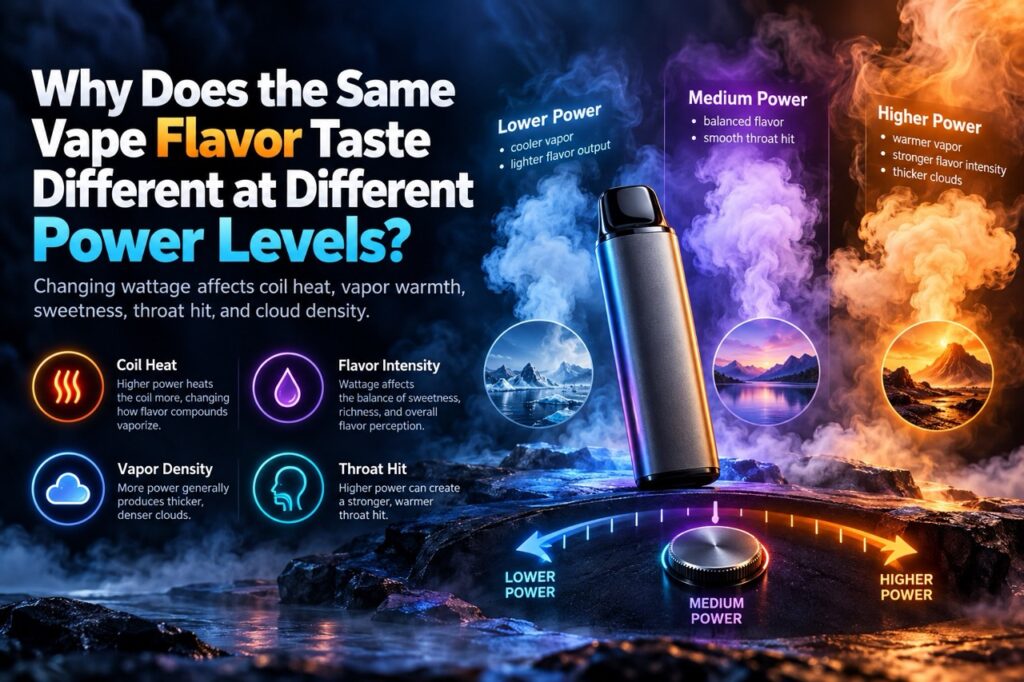
You find a flavor you like, crank up the power, and suddenly it tastes off. Flatter. Sharper. Maybe a little burnt. Same liquid, same device — so what changed?
Heat. That’s the whole answer. Power sets how hot the coil runs, and coil temperature shapes how your flavor actually tastes. Get a handle on that, and you can stop guessing and start dialing in.
These products contain nicotine, an addictive chemical, and are for adults 21 and older only.
Flavor Isn’t Fixed — It’s Made on the Spot
When the coil heats your e-liquid, it creates vapor. That vapor is what carries the flavor. The thing is, an e-liquid isn’t one ingredient — it’s a mix of flavor compounds, and each one has its own vaporization point.
Some release at low heat. Others need more before they show up at all. So when you change the power, you’re changing which of those compounds get released and in what amounts. The liquid hasn’t changed. What changed is how it’s being heated.
What Wattage Actually Does
More watts = hotter coil. Hotter coil = more vapor, faster.
On every puff, the power heats the wick, the wick vaporizes the liquid, and that vapor moves to your mouth. Turn up the power and two things go up together: vapor temperature and vapor volume. Turn it down and both drop.
One thing most people get wrong: more power doesn’t automatically mean more flavor. It means more heat. And once the heat passes the sweet spot for a given flavor, things start to fall apart. Delicate compounds burn off. Sweeteners scorch. The taste goes sideways.
How Flavor Type Affects the Equation
Different flavor styles react to heat differently. That’s why the same power setting works great for one profile and ruins another.
Fruit flavors are light and volatile. They peak at low to medium heat. Too much power and the fresh, bright notes burn off. What’s left tastes more like cooked fruit than the crisp, juicy hit you were expecting.
Dessert and cream flavors need more heat to open up. At low power, a vanilla or custard blend can taste thin or watery. A little more warmth brings the sweetness and body out. But push it too far and the sweeteners start to caramelize — you get a scorched edge that lingers.
Sour and tart notes are heat-sensitive. They come through best at moderate temperatures. High heat tends to flatten tartness or add a bitter aftertaste.
Menthol and ice flavors are different from the rest. The cooling effect is partly sensory — it’s a physical sensation, not just a taste. Warm vapor kills it. Lower power keeps the cold hit intact.
Complex, layered blends — anything mixing fruit, candy, and menthol, for example — take the most tuning. Each component has its own ideal heat. At any given wattage, some notes will shine while others get lost. Finding the balance takes a few tries.
Low, Medium, High: What Actually Changes
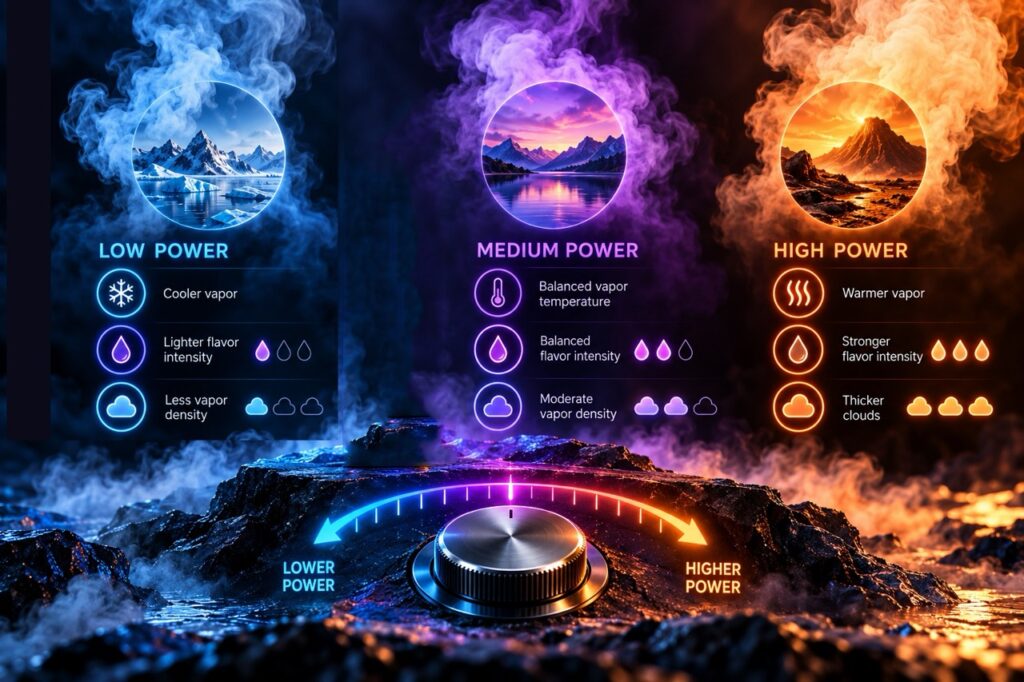
Low power gives you cool, light vapor. Flavor often feels thin because not everything vaporizes at low heat. Some notes barely register.
Medium power is where most flavors hit their best. Enough heat to release the full profile. Not so much that anything starts to break down.
High power means big, warm vapor and a strong punch. But you’re close to the limit. If the wick can’t keep up, you’ll get dry hits or a burnt taste. Flavor quality drops quickly once you cross that threshold.
Volume and Warmth Both Shape What You Taste
More vapor means more flavor molecules per puff — so it reads as stronger. Less vapor spreads the same flavor thin.
Temperature changes perception too. Warm vapor amplifies sweetness and richness. Cooler vapor tastes cleaner and crisper. Fruit and menthol usually come through better at lower temps; dessert and tobacco profiles often improve with a touch more warmth.
Because power changes both volume and temperature at once, even a small adjustment can shift the whole experience.
What About Nicotine Feel?
Power doesn’t change how much nicotine is in the liquid. It changes how much liquid you vaporize per puff.
Higher settings mean more vapor, so each draw delivers more nicotine and a firmer throat hit. Lower settings feel milder. That throat hit matters for flavor too — if the hit feels too sharp, it drowns out more subtle notes. Lowering the power often fixes harshness and improves flavor at the same time.
How to Find the Right Setting
Start lower than you think you need. Take a few puffs. Nudge the power up one step and taste again. Stop when the flavor tastes full and clean, before any harshness shows up.
If you get a dry hit or a burnt taste at any point, drop back down and give the wick a moment to soak before continuing.
A rough guide to start from:
- Fruit and citrus — low to medium
- Menthol and ice — low to medium
- Sour and tart — medium
- Dessert and cream — medium to slightly higher
- Tobacco and rich blends — medium to higher
Adjustable Power on Disposables
This used to be a mod-kit feature. Now it’s common on disposables too. Brands like Geek Bar and Raz include multiple power modes across many of their devices — usually a standard mode and a boost mode. If flavor control matters to you, it’s worth looking for a device that offers at least two output options rather than a locked fixed setting.
Frequently Asked Questions
Does higher wattage always give better flavor?
No. Flavor improves with power only up to a point. Past the right temperature, compounds break down and the taste turns harsh.
Why does my vape taste burnt at high power?
Either the heat is too much for the flavor, or the wick can’t soak up liquid fast enough. Lower the power and let the wick catch up.
Does a higher power mode make the nicotine stronger?
The nicotine level in the liquid stays the same. Higher power just vaporizes more per puff, so each draw feels stronger.
Should I use different power settings for different flavors?
If your device allows it, yes. Fruit and menthol tend to do better at lower settings. Desserts and tobacco often benefit from a bit more heat.
The Bottom Line
Same liquid, same device, different power — and the taste changes. That’s because power sets the coil temperature, and temperature controls which flavor compounds release, how much vapor you get, and how warm it feels when it hits.
Too little heat and the flavor stays flat. Too much and it breaks down. The best results come from starting low and stepping up until the flavor peaks. Once you know how your coil responds, tuning it becomes second nature.