
We love the first-day sparkle of a new Pop—the crisp box window, the flawless paint, the brag-worthy value. Leave that same figure on a sunny, dusty shelf for three months and resale trackers show prices can drop by as much as 50 percent.
That’s why smart collectors treat storage with the same care they give to hunting grails. In the sections ahead, we’ll compare sealed cases, glass cabinets, wall shelves, modular cubes, and bulk bins so you can keep every vinyl hero looking legendary.
How we picked the storage winners
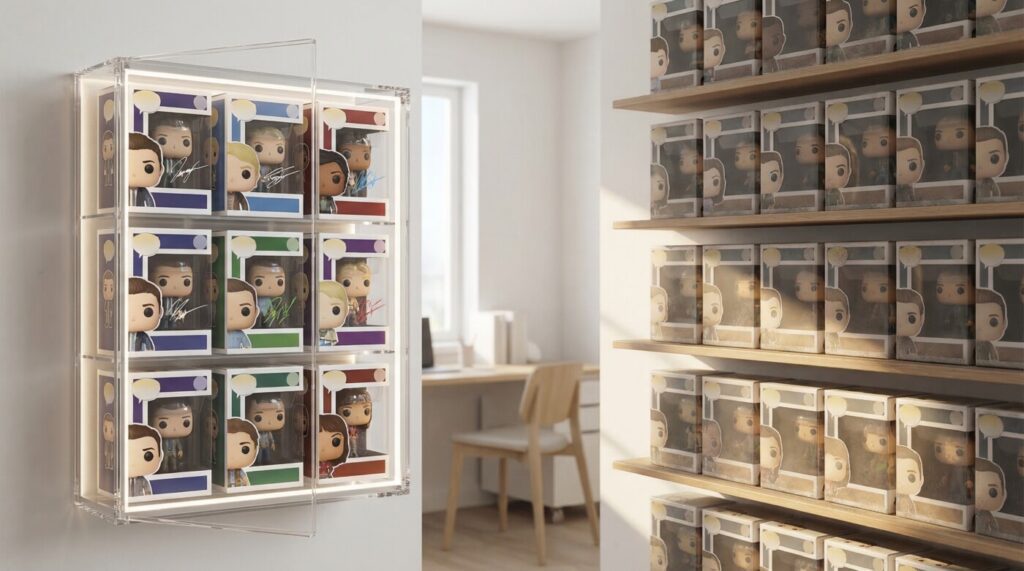
We started with a single question: What does a real-world collector need once the shelf fills up?
To answer it, we audited 14 “best display” round-ups, read hundreds of posts in r/FunkoPop and Funko Funatic, and interviewed five high-volume sellers who rotate stock daily. Their shared pain points—dust, UV fade, and rising floor-space costs—guided every decision we made.
Next, we filtered solutions through three hard gates:
- Current availability in the U.S.
If you can’t buy it (or its direct replacement) right now, it’s out. That’s why the beloved Detolf cabinet only appears in passing; IKEA retired it in 2024 and replaced it with the BLÅLIDEN line. - Scales past a starter set.
Each pick must hold at least five standard 4-inch Pops and provide a clear path to expand as your haul grows. - Verifiable protection or capacity data.
We only included products with published dimensions, material specs, or lab-tested UV-blocking numbers.
When a product passed those gates, we graded it on five weighted factors:
Protection (25%), Scalability & capacity (20%), Display aesthetics (15%), Cost & value (15%), Ease of setup & space efficiency (15%). We added a 10 percent bonus for broad availability or simple DIY plans.
Finally, we grouped like with like. Closed cases and glass cabinets formed the Dust-proof displays segment, while open shelves and bookcases filled the High-capacity displays lane. Mini rankings inside each segment prevent apples-to-oranges comparisons.
The outcome is a list that skips hype, leans on numbers, and highlights options you can order tonight.
Dust-proof displays
Sealed displays are the collector’s equivalent of a hazmat suit. Dust stays out, UV rays bounce off, and curious pets lose their front-row seats. We open with the premium end of the spectrum because that is where your most valuable Pops belong.
Vaulted premium acrylic cases
Picture a museum vitrine, only sized for vinyl heroes instead of ancient pottery. That is the vibe Vaulted chases, and it largely nails it.
The build feels rock-solid from the first click of the magnetic door. Six-millimetre (0.24-inch) acrylic walls turn each nine-Pop cubby into a micro-fortress, and product specs on Vaulted confirm the panels include a UV filter that blocks roughly 98 percent of harmful light. Translation: box art stays vibrant, signatures stay crisp, and you spend Saturdays hunting exclusives instead of scrubbing shelf grime.
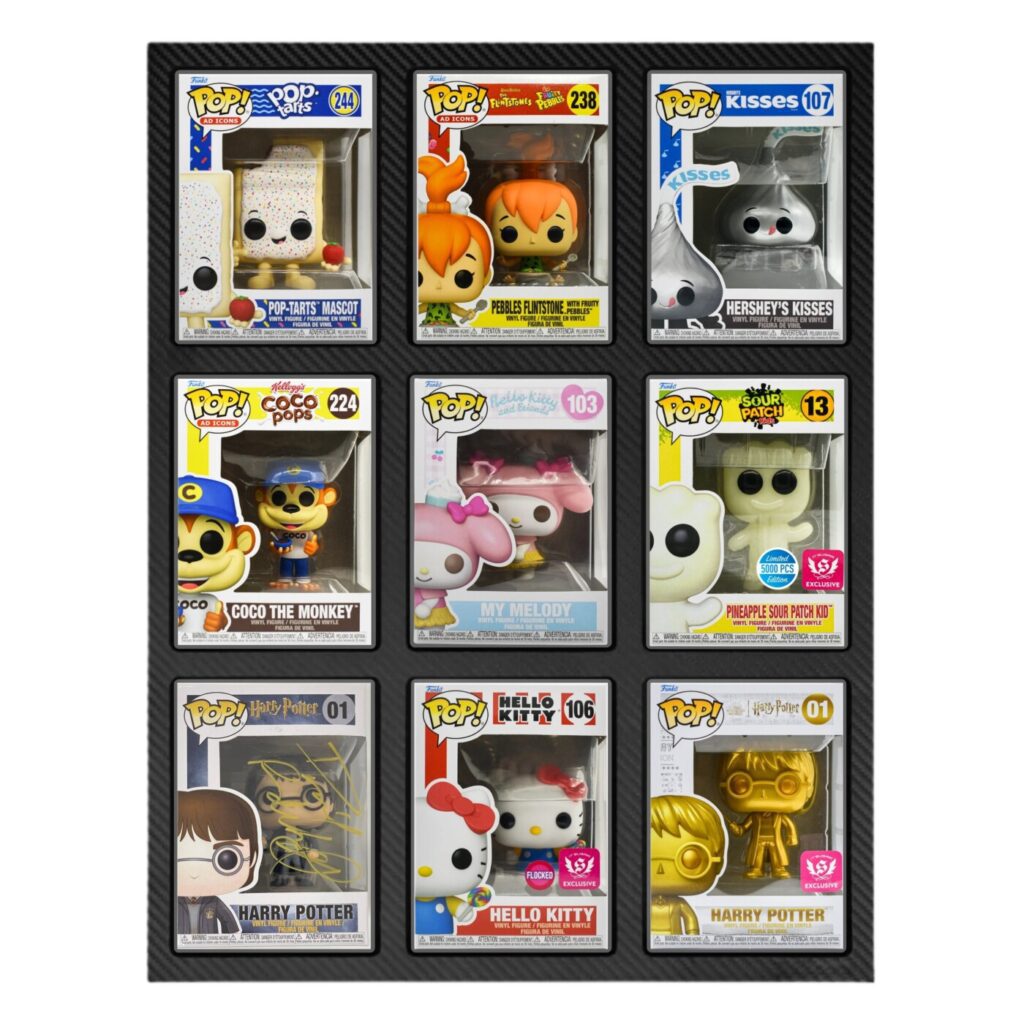
Vaulted premium acrylic Funko Pop display case UV-protected product photo.
Modularity is Vaulted’s secret strength. Each unit stacks cleanly, so you can add one cube at a time rather than committing to a seven-foot cabinet on day one. Wall-mount slots are pre-drilled; countersunk screws sit flush once hung, leaving nothing but floating Pops and a subtle LED glow if you choose the lighting kit.
Cost per figure is the sticking point. At roughly $100 for a nine-slot case, you pay about $11 per Pop, five times a basic wall shelf. Yet for grails worth $50 or more, that math flips. Protecting a $200 convention exclusive for $11 is a bargain and lets you display commons on cheaper shelving without losing sleep.
Is a Vaulted wall practical for a 300-Pop hoard? Probably not. Is it perfect for the ten signatures you guard like dragon treasure? It sure is. Start with one module, add as milestones arrive, and you will build a gallery that looks intentional instead of improvised.
Ikea glass cabinets: closed displays on a budget
If Vaulted is a boutique gallery, Ikea’s glass cabinets feel like the neighborhood art fair—humble, accessible, and surprisingly good when styled well.
The long-loved Detolf set the standard, but Ikea removed it from shelves in 2024 and replaced it with the near-twin BLÅLIDEN. The silhouette and clear panels remain, while hardware received a small upgrade. Collectors still trade Detolfs second-hand, but new buyers now have a cabinet they can grab this weekend. House Digest reports that Ikea shifted to lighter, faster-assembly storage lines to cut shipping weight and cost.
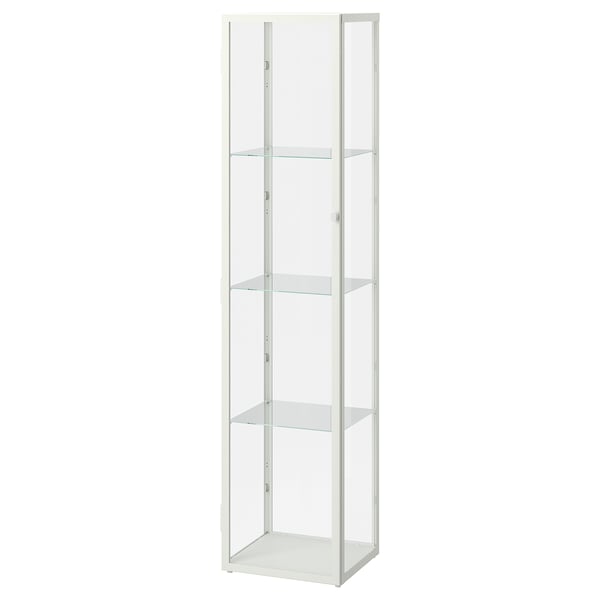
Ikea BLÅLIDEN glass display cabinet for Funko Pop collections.
Protection is solid for the price. Tempered glass panels and a front door cut dust by about 85 percent. Small air gaps remain, so you will wipe shelves quarterly instead of weekly, but that beats fighting a full-blown fuzz invasion. Keep the cabinet a step back from windows to avoid direct sun, or add a low-cost UV window film if your collection room doubles as a sunroom.
Capacity is where BLÅLIDEN shines. Four fixed shelves hold roughly 16 to 24 boxed Pops depending on risers, or 30 loose figures if you free them from plastic prisons. Place two cabinets side by side and you have a mini Funko storefront for under $200.
Assembly is a rite of passage. Budget an hour, a handful of Allen screws, and a second set of hands for the tall glass side panels. Secure the finished case to a wall stud. A tipped cabinet full of vinyl crushes spirits and boxes in equal measure.
Bottom line: BLÅLIDEN delivers about 70 percent of Vaulted’s dust control for one-third the cost per Pop. That trade makes sense for medium-sized collections and anyone chasing a sleek look without premium pricing.
Wall-mounted shelves: maximum Pops, minimum footprint
Sometimes you want every figure visible at once. Open wall shelves turn a blank wall into a comic-con backdrop and keep your floor clear for, well, living.
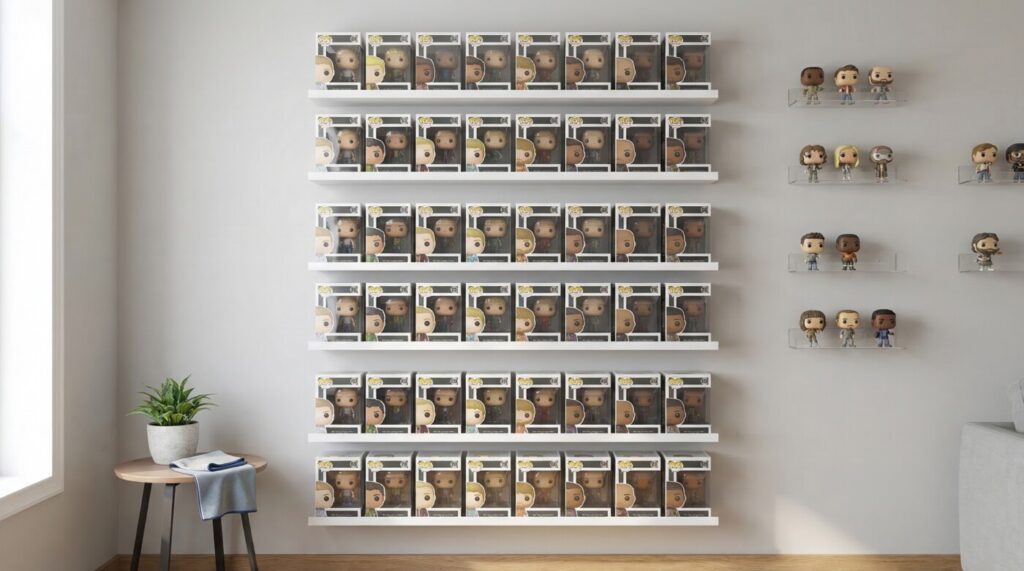
Display-specific brands such as DisplayGeek cut shelves to Pop-box depth, so boxes sit flush without teetering. Each three-tier module holds 18 boxed Pops yet protrudes only 5 in. Stack three modules and one vertical strip showcases about 54 figures while costing roughly the same as one premium acrylic case.
Prefer a cleaner look? Floating acrylic ledges seem to vanish against drywall, making boxes appear to hover. Pick up a six-pack online for about $30, span an 8 ft wall, and you create parking for 100 loose Pops with no carpentry degree required. Anchor into studs or use heavy-duty toggle bolts; vinyl armies gain weight fast.
Dust is the trade-off. Open shelves collect fuzz within weeks. To stay ahead, set aside two minutes each weekend, swipe a microfiber wand across every row, and you are done. Sunlight is the bigger villain. Mount shelves opposite windows or apply UV film to the glass, and future you will thank you when box windows stay crystal clear.
Shelves excel at scalability. Add a new tier the same night you impulse-buy another case of exclusives. No re-engineering and no furniture shuffle, just another row and another brag session. For collections racing past triple digits, that headroom is priceless.
Standard bookcases and DIY racks: bulk storage with style
When the collection shifts from “neat wall display” to “I could open a small shop,” ordinary furniture steps up. A six-shelf Billy bookcase from Ikea holds 90 boxed Pops. Place boxes two deep and capacity climbs to 150, though you lose front-row visibility.
Why does a basic bookcase work so well? Depth. Most units measure 11 in (28 cm) front to back, enough for a box and a half. That space leaves room for risers, LED strips, or a hidden power bar. Adjustable shelves mean 6 in dragons and 10 in Pokémon finally get a throne that fits.
The trade-off is dust. Doors are optional, but adding Ikea’s glass Morliden fronts or inexpensive acrylic sheets on hinges provides cabinet-like protection for a fraction of a custom build. Seal the edges with weather-stripping and you approach sealed-case territory without picking up a router.
DIY builders can push capacity further. One weekend, $60 of pine, and a pocket-hole jig create a wall-spanning cubby grid that stores 100 boxes in a tidy, photo-ready matrix. Cut shelf height to 7 in—just taller than a Pop box—so no vertical space is wasted.
Reinforce long shelves with centre supports; vinyl is light, but cardboard plus protectors adds weight quickly. Quick rule: if a shelf sags when empty, it is unsafe when stacked five Pops deep.
Bookcases and custom racks suit collectors racing toward triple-digit counts who want order over showroom polish. They turn overflow into a curated library guests can browse like graphic novels.
Hybrid helpers: pop protectors and hard cases
Open shelves look gorgeous until you sneeze. Individual protectors act like tiny hazmat suits for each box, letting you enjoy that wall-to-wall display without flinching when dust drifts by.
Soft PET sleeves are the everyday workhorses. They fold flat, cost about $1, and snap around a standard Pop box in seconds. Once fitted, you dust the sleeve, not the collectible, and minor bumps leave no corner dings. Pick up a 20-pack and armor your commons before they ever touch a shelf.
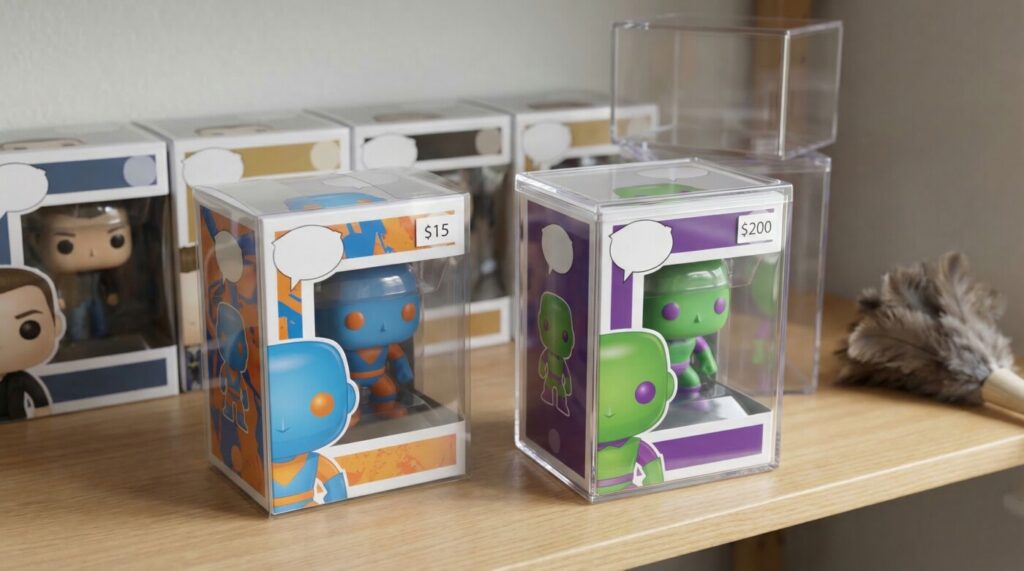
Graduating to hard stacks feels like moving from cloth sneakers to steel-toe boots. Rigid polycarbonate walls stop crush damage cold and add enough strength to stack up to four boxes high without warping. Veteran sellers follow a simple rule: if a Pop’s value exceeds $50, slide it into a hard case. The $11 outlay saves heartache down the road.
Premium options—magnetic lids and UV-blocking acrylic—creep close to display-case pricing, yet they let you blend sealed and open storage. High-value pieces stay mint on the shelf next to loose figures, giving you a single, unified display instead of two parallel worlds.
Protectors do not eliminate dusting, and they cannot forgive direct sunlight. Still, for collectors who prize quick access and want every box front visible, they provide a smart middle ground between bare boxes and glass cabinets. Suit up, dust less, and keep stacking.
Stackable display cubes: LEGO-style growth for evolving collections
If closed cabinets feel too permanent and open shelves feel too exposed, modular cubes split the difference. Think of them as plastic LEGO bricks, only each brick holds 12 Pops behind a clear dust cover.
Take the popular 12-slot Welloux box: four Pops wide, three Pops high, a flip-front lid, and interlocking grooves on every edge. Buy one today, show off your favorites, then snap a second on top when the next convention haul arrives. Two cubes form a tidy tower; three create a mini wall. No tools, no hardware-store run required.
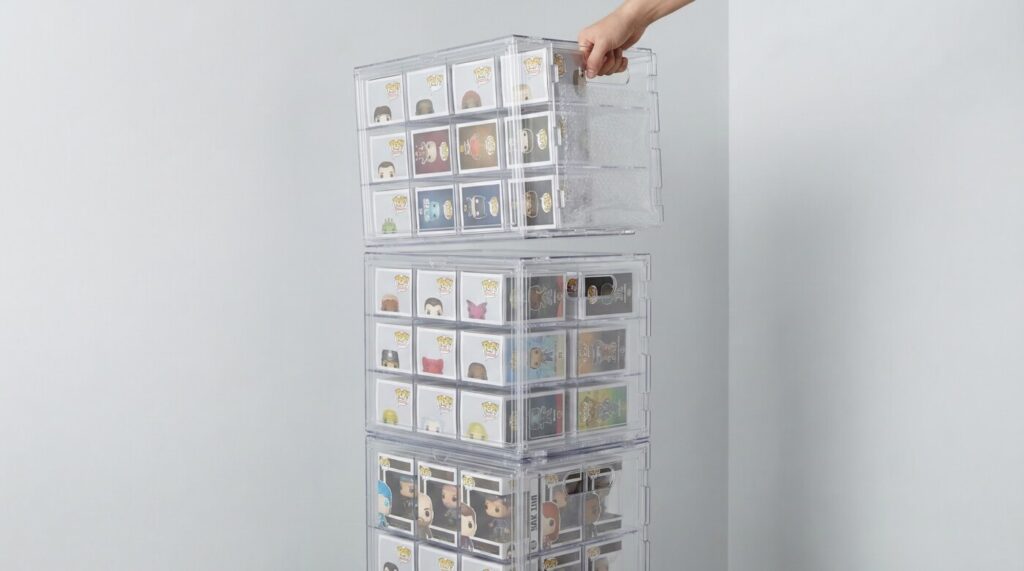
Protection lands between a glass cabinet and an open shelf. The front door locks with tension clips, blocking most dust while leaving tiny vents around the edges. A quick wipe every few months keeps panels clear. UV defense is minimal, so follow the same sunlight rules we give for shelves: indirect light or window film.
Capacity math is compelling. At $45 per cube, you pay roughly $4 per protected Pop, cheaper than premium cases yet cleaner than bare shelving. Because cubes match box depth, they waste zero space, a win for apartments where every inch matters.
Weight becomes critical once you stack beyond three units. The maker lists a three-high limit on carpet and four on solid flooring. Stick to it. If you want a ceiling-high Pop wall, anchor the tower to a stud with an L-bracket. The fix takes five minutes and prevents a heart-stopping crash.
Traveling collectors love that each cube doubles as a carry case. Pop the lid, add bubble wrap, and your signed exclusives ride safely to the next trade night. Back home, the cube clicks into the display with no repacking.
Modular cubes may not replace a statement glass cabinet, but they win on flexibility. Add, rearrange, relocate; your storage grows at the same pace your collection does.
Bulk bins and climate hacks: taming the inevitable overflow
No matter how careful your display plan, a day comes when new Pops outnumber open slots. The extras need a safe, low-maintenance home until rotation time or resale. Enter the humble plastic tote.
Choose clear polypropylene bins with gasket-sealed lids. A 60-quart “Really Useful Box” or IRIS WeatherPro tote holds 20–30 boxed Pops standing upright. The gasket keeps dust and most moisture at bay, and the clear walls let you identify contents without popping lids.
Store bins in climate-controlled spaces such as closets, under beds, or finished basements that stay between 65 °F and 75 °F. Vinyl hates attic heat and damp garages. Slip two silica gel packs into each tote so humidity stays below 50 percent, stopping mold before it starts.
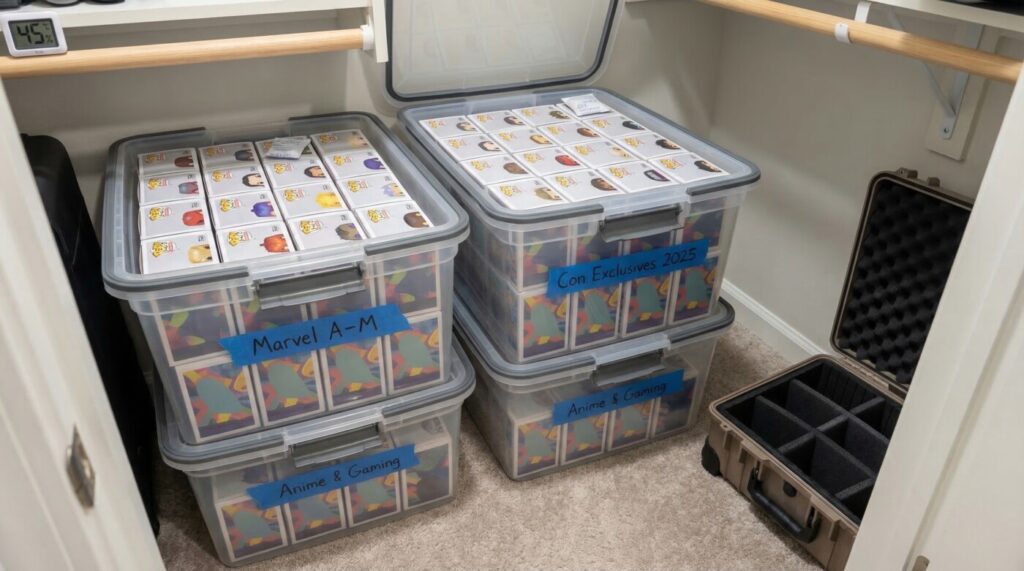
Label everything. A strip of painter’s tape on the front might read “Marvel A–M,” or “Con Exclusives 2025,” making swaps painless. When it is time to refresh the display, grab the right bin instead of digging through a plastic avalanche.
If you travel with Pops for signings or trade nights, consider a hard-shell rolling case with foam dividers. Camera and drone cases work well once you pluck the perforated foam into Pop-size rectangles. The same case parks neatly on a shelf when you are home, doubling as dark storage between events.
FAQs
(No frequently asked questions were provided with the original article.)
Conclusion
Bulk storage is not glamorous, but it protects the pieces you do not have room to celebrate right now. Think of it as the vault backstage while the headliners soak up the spotlight out front.